Seven days. To some people, this sounds like not enough. To the traveler who has been saving up their one annual week of leave, planning for eighteen months, and quietly moving Egypt from the “someday” pile to the “this year” pile — seven days is everything.
I’ve spent fifteen years guiding Egypt trips of every length. The ten-day travelers see more. But I have watched countless seven-day travelers leave with something the ten-day travelers don’t always have: intensity. When every day counts, every day is felt. When you know Abu Simbel is happening tomorrow and Karnak is happening the day after, you arrive at each one completely present.
Seven days is enough for Egypt’s essential story: the last surviving Wonder of the Ancient World, the complete treasures of Tutankhamun, the temple that defied a dam, the colossal solitude of Abu Simbel at dawn, and the Valley of the Kings before the tour buses arrive.
Is it enough? Yes. Is it everything Egypt offers? No. But everything it offers, it gives completely. Here is how to spend your seven days.
Is 7 Days Enough for Egypt? The Honest Answer
Let me answer the question that every first-time traveler quietly carries: yes, seven days is genuinely enough to experience Egypt’s essential story. A classic egypt itinerary 7 days covers Cairo and the Giza Plateau, the Grand Egyptian Museum, Aswan with Philae and Abu Simbel, and Luxor’s East and West Banks. Nothing critical from a first-visit perspective is missed.
What seven days can’t cover: Saqqara and Dahshur (the older, pre-Giza pyramid fields), a full multi-night Nile cruise, Alexandria, or a Red Sea extension. These are wonderful — they are simply for your second Egypt trip, not your first seven days.
The key difference from 10 days: on a 7-day itinerary, you trade Saqqara and Dahshur for a tighter Cairo program, and you reduce Luxor to two focused nights instead of three. Both are manageable trade-offs. The ancient story — from the Pyramids to Abu Simbel to the Valley of the Kings — remains completely intact.
“Seven days is not a compromise. It is a focused gift — every day is essential, nothing is wasted. What you give up in quantity you gain in intensity.”
7-Day vs. 10-Day Egypt Itinerary: What’s Covered and What’s Cut
Category | 7 Days ✔ | 10 Days ✔ | Best For |
Giza Pyramids + Sphinx | ✔ | ✔ | Both |
Grand Egyptian Museum | ✔ | ✔ | Both |
Saqqara & Dahshur | ✘ | ✔ | 10 days |
Islamic Cairo (full) | ✘ (evening only) | ✔ | 10 days |
Aswan — Philae + High Dam | ✔ | ✔ | Both |
Abu Simbel | ✔ | ✔ | Both |
Kom Ombo + Edfu | ✔ (day 5) | ✔ | Both |
Luxor West Bank (full) | ✔ | ✔ | Both |
Karnak Temple | ✔ | ✔ | Both |
Luxor — nights | 2 | 3 | 10 days richer |
Alexandria | ✘ | ✔ | 10 days |
Red Sea extension | ✘ | ✘ (14 days+) | Extended |
The Route — Why We Go South First
Every experienced Egypt guide will tell you the same thing: fly south first, travel north. It is not arbitrary. The recommended sequence for a 7-day Egypt trip — Cairo (2 nights) → fly to Aswan (2 nights) → travel north to Luxor (2 nights) → fly home from Luxor — follows the logic of the Nile itself.
The south-first rationale: The Nile flows northward. Traveling from Aswan to Luxor echoes that natural direction, and the ancient Egyptian story — from the earliest Nubian temples at Abu Simbel through the New Kingdom tombs of Luxor — builds chronologically as you move north. By the time you reach Karnak on Day 7, you have the full context. You understand what you’re standing in.
There is also a practical rhythm to this sequence. Cairo is cosmopolitan and complex — a gentle introduction before the intensity of Upper Egypt. Aswan is slower, quieter, Nubian in character. Historically, Luxor has been the most densely populated city on the route. Finishing there, when your knowledge and appreciation are highest, is exactly right.
7-Day Egypt Itinerary: At-a-Glance Summary
Day | Location | Highlights | Route A / B Note |
Day 1 | Cairo (arrive) | Nile Corniche, settle in | Same both routes |
Day 2 | Cairo | Giza Pyramids, GEM, Khan el-Khalili | Same both routes |
Day 3 | Fly → Aswan | Philae Temple, felucca sunset | Route B: Abu Simbel AM flight + board cruise PM |
Day 4 | Aswan | Abu Simbel, High Dam, Nubia Museum | Route B: Aswan sites + Cruise Day 1 |
Day 5 | Aswan → Luxor | Kom Ombo, Edfu, Luxor Temple night | Route B: Sail (Kom Ombo + Edfu) Cruise Day 2 |
Day 6 | Luxor — West Bank | Valley of Kings, Hatshepsut, Medinet Habu | Route B: West Bank — Cruise Day 3 |
Day 7 | Luxor — East Bank | Hot air balloon, Karnak, Luxor Museum | Route B: Karnak, disembark, fly home |
Route A — The Classic 7-Day Land-Based Egypt Itinerary
Day 1 — Cairo Arrival: The City Lands on You Slowly
Cairo International Airport arrivals hall. The noise, the warmth, the smell of coffee and diesel and something you can’t quite name. Your guide holds your name on a board. The city begins.
The most important rule for Day 1: do not plan anything ambitious. Egypt rewards gradual arrival. Cairo is one of the world’s great megacities — seventeen million people, ancient and hypermodern in the same breath. Give yourself the evening to absorb it.
After check-in and a brief rest, walk the Nile Corniche as the sun drops. The river at dusk is extraordinary — the feluccas catching the last light, the city skyline deepening, the evening call to prayer drifting across the water. Find a local restaurant near your hotel, order koshary or grilled fish, sleep early.
• Where to stay: Downtown Cairo (near Tahrir Square) puts you close to the Egyptian Museum and the pulse of the city. Giza hotels offer pyramid proximity for an early Day 2 start.
💡 Local Insider Tip: Ask your driver to take the Corniche road from the airport if time allows — your first view of the Nile at night, lit up and alive, is the perfect introduction to what Egypt’s river actually means. |
“Give Cairo tonight. She will give you everything else tomorrow.”
Day 2 — Cairo: Pyramids, Sphinx & the Grand Egyptian Museum
The Giza Plateau at 6:30 in the morning. The car turns off the ring road and suddenly — directly ahead in your windshield, filling it completely — the Great Pyramid of Khufu. Nothing on earth prepares you for the first sighting. After a lifetime of photographs, the reality of its scale is still a shock.
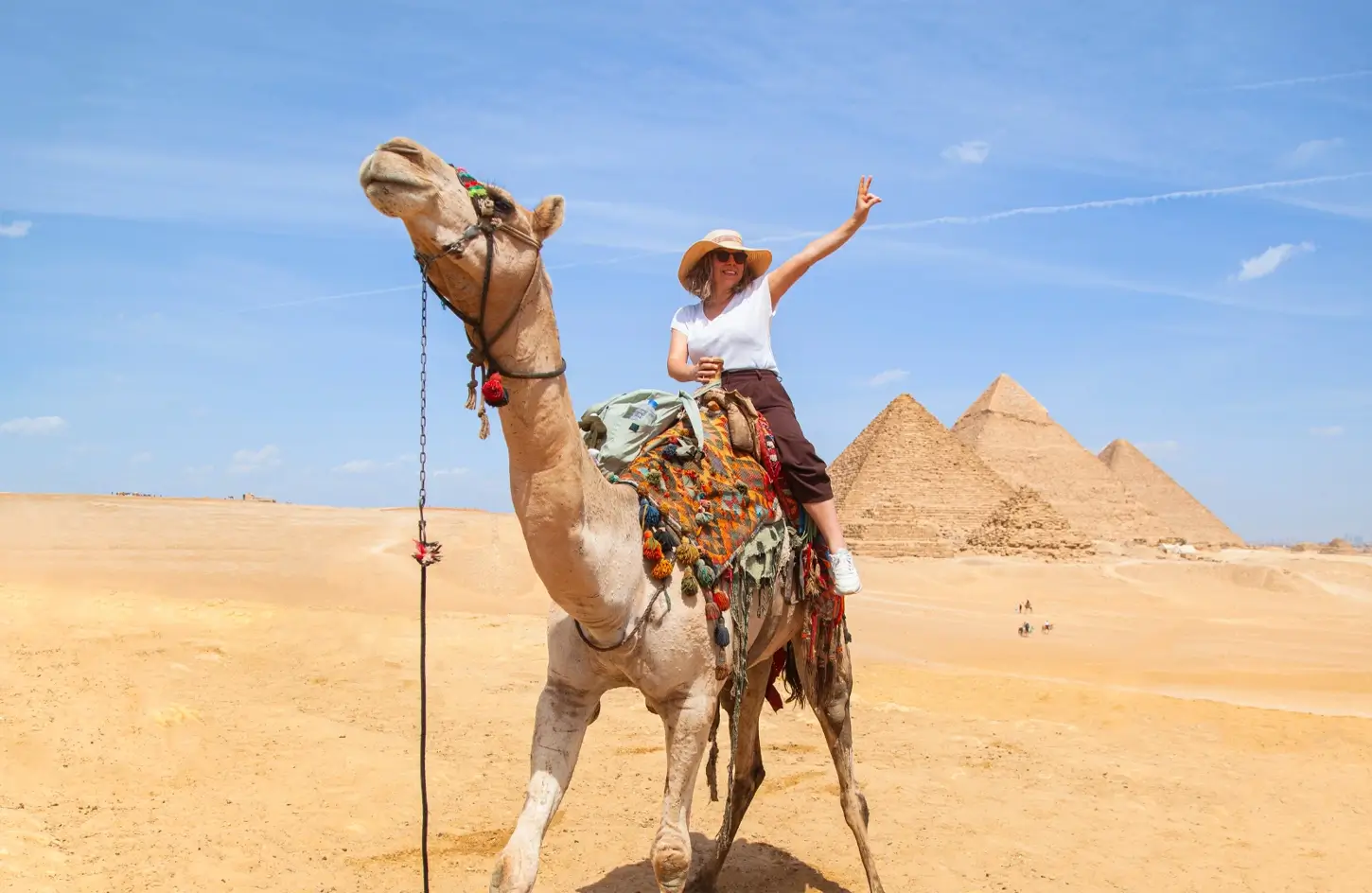
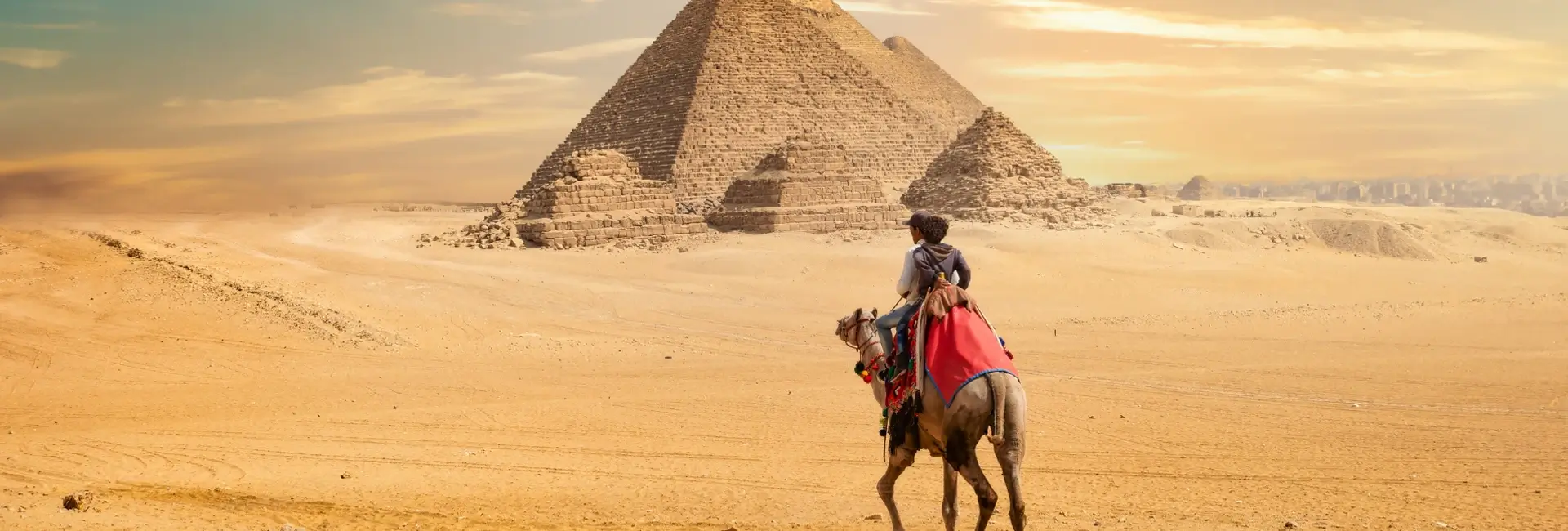
Depart at 6:30 am sharp to arrive at the plateau as the gates open at 7 am. The first two hours, before the tour convoys assemble, the Giza Plateau has a scale and silence that disappears by mid-morning. Spend three hours here: the Great Pyramid of Khufu (138 meters, built over approximately 20 years by an estimated 20,000 workers), the Pyramid of Khafre with its remaining limestone casing at the apex, the smaller Pyramid of Menkaure, and the Great Sphinx — 66 meters long, carved from a single limestone outcrop, watching the horizon since approximately 2500 BCE.
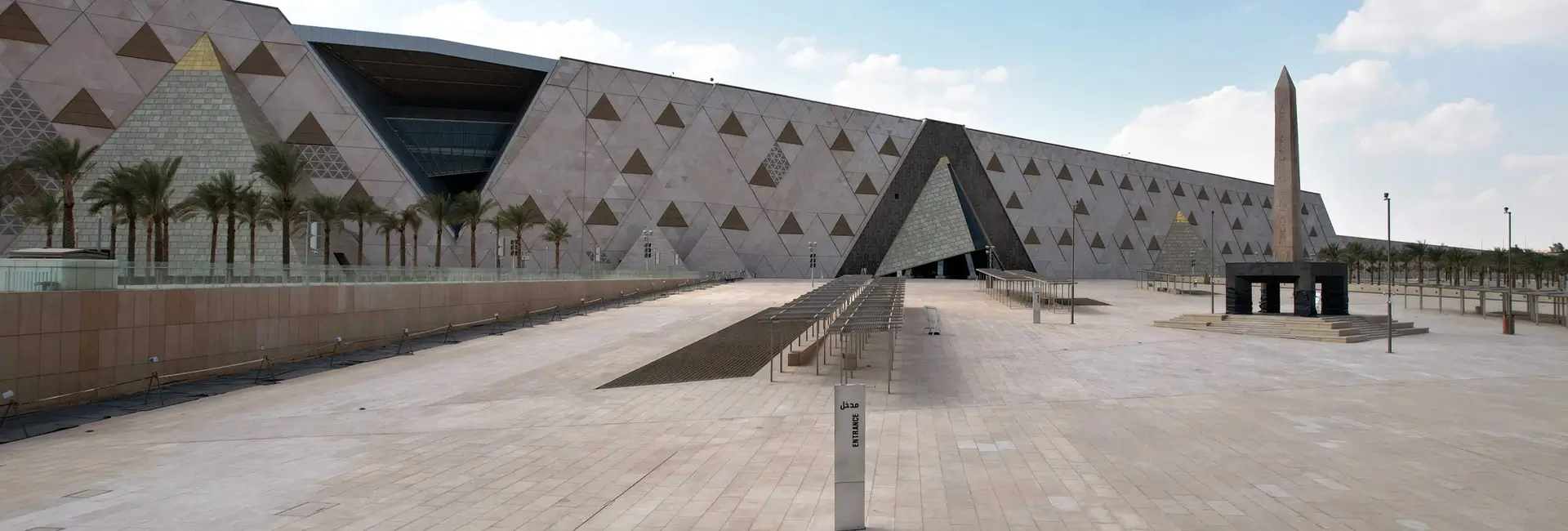
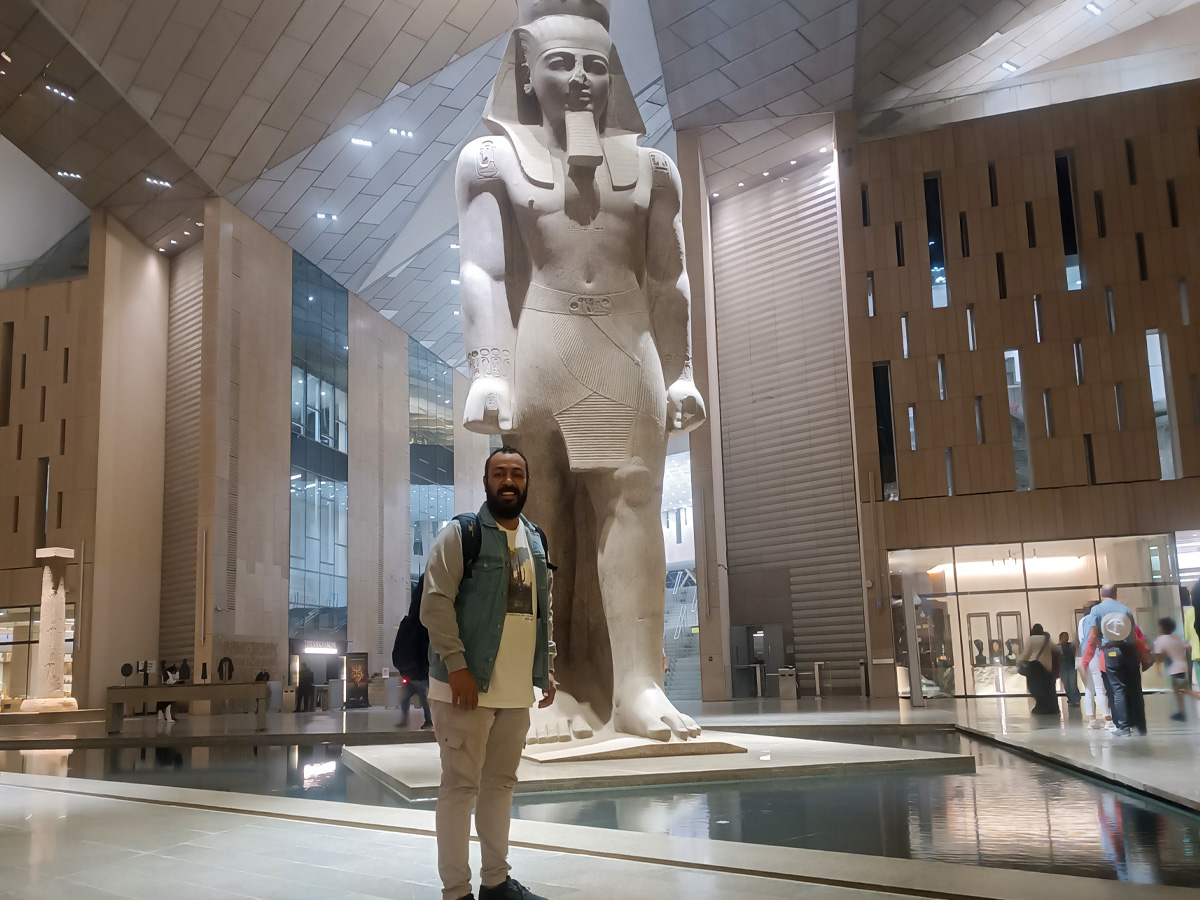
By 10:30 am, transfer to the Grand Egyptian Museum. This is the largest archaeological museum on earth — over 100,000 artifacts across 90,000 square meters of exhibition space. Allow 2.5 hours minimum. The Tutankhamun Galleries alone contain over 5,000 objects, including the Golden Throne, the ceremonial chariots, and the famous death mask. Book timed-entry tickets in advance at
Midday is rest time. This is not optional advice — Egypt’s midday sun in a city of this pace is genuinely punishing. Return to your hotel, eat, air-condition, rest. You will need your energy for the evening.
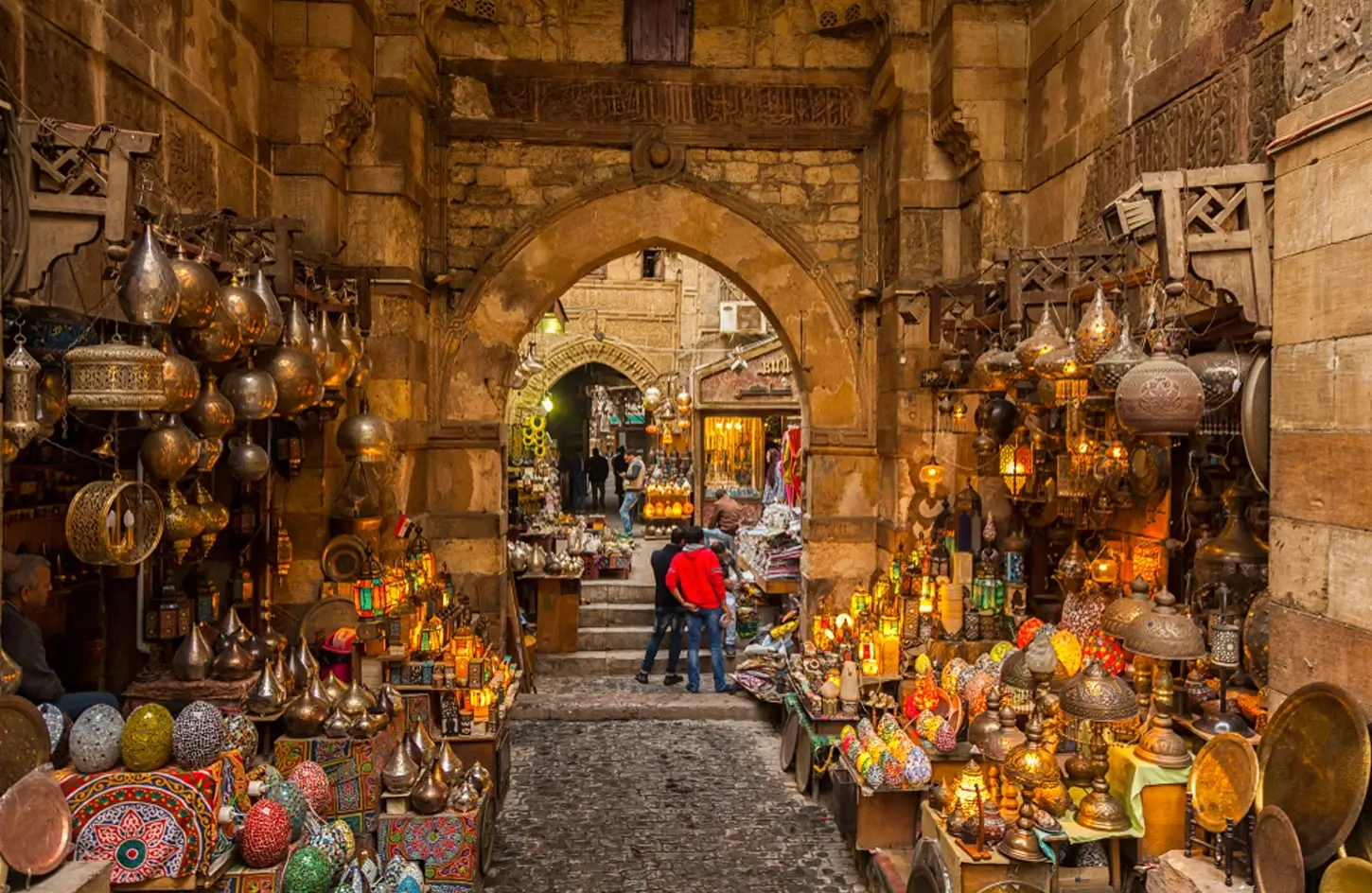
The evening is Khan el-Khalili, Cairo’s medieval bazaar, established in 1382. Walk the narrow alleys, haggle for papyrus or cartouche souvenirs, drink tea at the famous El-Fishawi coffee house (open continuously since 1773), and end with dinner in the surrounding Islamic quarter. This is the atmospheric Cairo evening that the city was built to offer.
💡 Local Insider Tip: The golden hour at Giza — the 45-minute window as the sun rises over the eastern desert, bathing Khufu’s limestone in amber — is among the finest photographic moments in all Egypt travel. Day 2 at 7am is the only time this week you’ll see it. |
“Day 2 is the most historically significant single day most travelers will ever have. The last surviving Wonder of the Ancient World in the morning. The complete treasures of Tutankhamun before lunch. Neither requires apology.”
Day 3 — Fly to Aswan: The South Begins
The aircraft descends into Aswan, and you understand immediately that this is a different country. The Nile below is wider, darker, and slower. The desert is closer on both sides. The city itself is quiet, sandstone-coloured, draped along the eastern bank with an elegance that Cairo never attempts.
Book the earliest morning flight from Cairo to Aswan (approximately 1 hour). EgyptAir operates multiple daily connections — book 2–3 months in advance during peak season (October–April). From the airport, transfer directly to your hotel. Aswan’s pace will recalibrate you within the first hour. No horns. No rush.
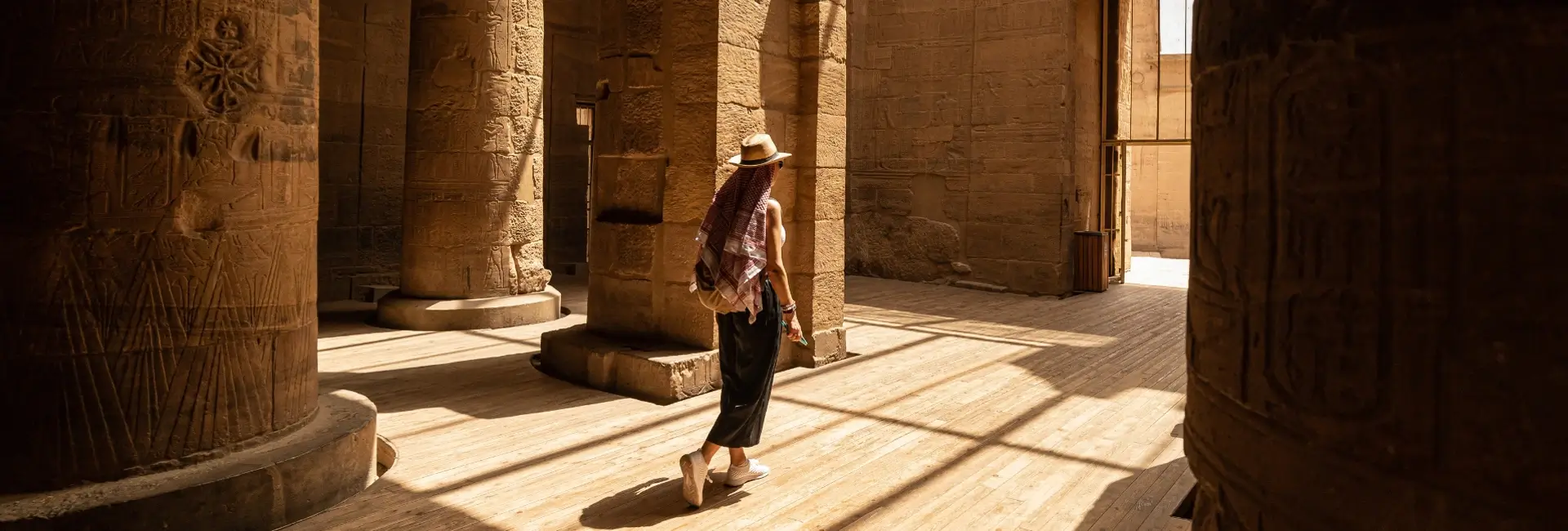
In the afternoon, take the short motorboat to Agilkia Island for Philae Temple — the island sanctuary of Isis, relocated stone by stone during the 1970s UNESCO campaign to save it from rising Lake Nasser waters. The transfer by felucca boat across the turquoise water, the temple rising from the palms, the painted reliefs still holding color after two millennia: this is Aswan at its most extraordinary.
As evening approaches, negotiate with one of the felucca captains along the Corniche for a sunset sail. An hour on the Nile as the sun drops behind the West Bank dunes, the Aga Khan Mausoleum silhouetted above, the water turning from blue to gold to amber: this is the felucca experience Egypt travel is built on. There is no better introduction to Upper Egypt.
💡 Local Insider Tip: Philae Temple is best in the afternoon light when the sandstone glows warm gold and the shadows deepen the bas-reliefs. If your flight arrives early, take the afternoon Philae visit and save the felucca for after — the sequence is perfect. |
“The moment you arrive in Aswan, the whole feeling of your trip changes. Slower. Quieter. More generous. The Nile here is the Nile as the ancient Egyptians knew it.”
Day 4 — Abu Simbel + Aswan Sites
4:30 am. Still dark. The hotel corridor is quiet. Your driver is waiting at the entrance. The road south is empty and the desert sky is extraordinary — the Milky Way visible in a way it never is in the city. You drive towards Abu Simbel, and ahead, after two hours of desert road, floodlights appear on the horizon.
Two options for reaching Abu Simbel: fly (45 minutes, depart by 6am, most practical on a 7-day schedule) or drive the desert road convoy (approximately 3.5 hours, depart Aswan by 3:30–4am, government-organized convoy system for security). The flight is strongly recommended for time efficiency. Either way, arrive before 8am to experience the site before the tour groups assemble.
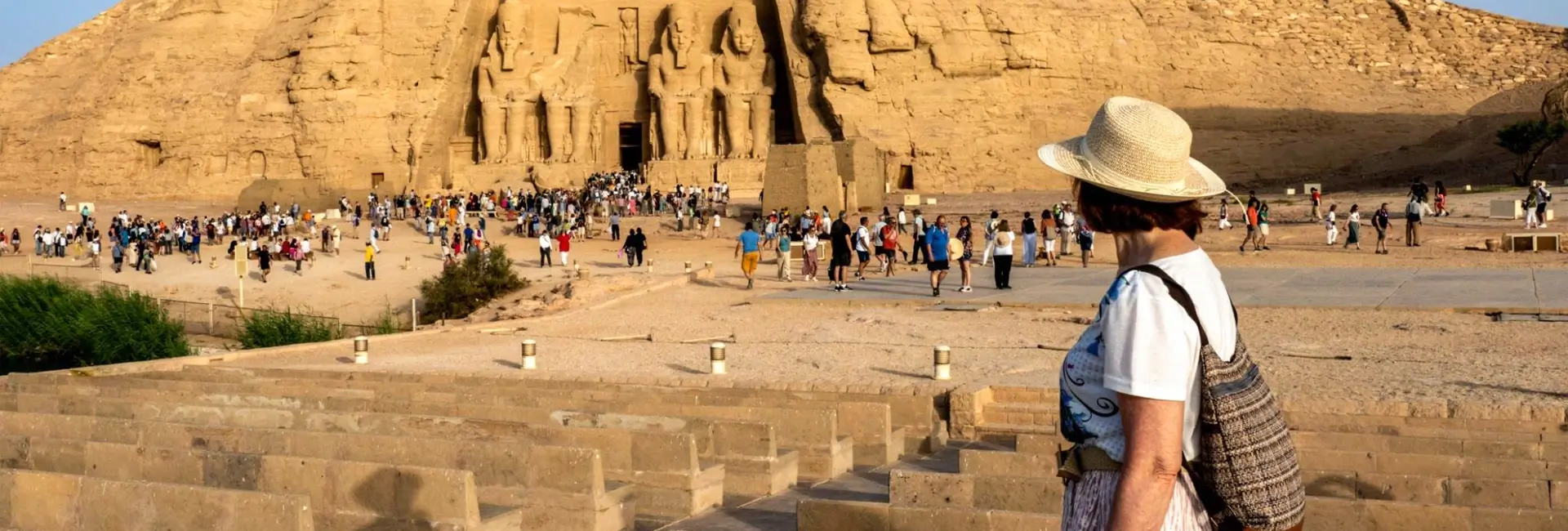
The Great Temple of Ramesses II is, without qualification, one of the greatest things a human being can stand in front of. Four colossi of the pharaoh, each 20 meters tall, carved directly from the Nubian sandstone cliff, were erected around 1265 BCE. The interior Hall of Hypostyle Columns, the painted walls, the inner sanctuary where twice a year the sun aligns to illuminate the statues of the gods — two hours here is not enough, and it will feel like ten minutes.
The smaller Temple of Nefertari, dedicated by Ramesses to his queen, is equally extraordinary in its intimacy. Note the carved scenes where Nefertari herself is depicted in the same scale as a god — an almost unique honor in ancient Egyptian royal iconography.
Return to Aswan by midday. After lunch and a brief rest, visit the Aswan High Dam (the engineering project that both saved Philae and submerged ancient Nubia), the Unfinished Obelisk lying in its quarry (a 42-metre obelisk abandoned in situ when a crack appeared during carving, offering extraordinary insight into ancient stonecutting techniques), and the Nubia Museum — 1.5 hours in a beautifully designed exhibition covering 5,000 years of Nubian history and culture. The Nubia Museum is the emotional and cultural heart of Aswan and consistently undervisited.
💡 Local Insider Tip: Abu Simbel on Day 4 looks brutal on paper: a 4–5 am start and a full afternoon in Aswan afterward. In practice, it is one of the most extraordinary days anyone will spend in Egypt. You will not have one regret. Arrive at Abu Simbel by 7 am before the convoy groups appear. |
“Abu Simbel is the non-negotiable. This day is long and early, but it is one of the most extraordinary days you will ever spend on earth. The drive back through the Nubian desert, the Nubia Museum in the late afternoon, quiet — you will remember this day for the rest of your life.”
Day 5 — The Road to Luxor: Kom Ombo & Edfu
Driving north from Aswan through the Nile Valley is one of the finest journeys in Egypt. The landscape is a study in contrast: a narrow green ribbon of cultivated land, palms and sugar cane, and then — immediately beyond the irrigation edge — the desert. Gold and beige extending to the horizon, interrupted by a limestone cliff, a distant temple, a felucca moving in silence on the river.
Depart from Aswan in a private car at 8 am. The direct drive to Luxor takes approximately 3 hours; with both temple stops, it is a comfortable 5–6 hour journey, arriving in Luxor by mid-afternoon.
Kom Ombo Temple (1 hour stop): a double temple, unusually dedicated to two gods — Sobek, the crocodile god, and Horus, the falcon god — built during the Ptolemaic period, perched dramatically on the eastern Nile bank. The setting alone is worth the stop. Inside, the Crocodile Mummy Museum displays dozens of mummified crocodiles discovered nearby, an extraordinary gallery that puts the cult of Sobek in immediate physical context.
Edfu Temple (1.5 hours): the most completely preserved ancient Egyptian temple in existence. Built between 237 and 57 BCE and buried under desert sand until the 19th century, its walls are covered floor-to-ceiling in carved and painted reliefs of exceptional quality. Arrive by the traditional method — a short ride in a horse-drawn calèche from the Nile bank to the temple entrance. The pylon gateway, 36 meters high, is the finest surviving example of Ptolemaic temple architecture.
Arrive in Luxor by late afternoon. After checking in, walk to Luxor Temple as the evening call to prayer fills the air and the city’s ancient stones begin to glow amber under the floodlights. The Avenue of Sphinxes — a 2.7-kilometer processional road of 1,000 human-headed sphinxes, now fully excavated — is lit beautifully at night, and the reflections in the Nile are extraordinary. This is the Luxor night the ancient architects intended.
💡 Local Insider Tip: I reverse the usual Kom Ombo / Edfu order: Edfu in the morning (cooler air, better light on the carvings), Kom Ombo in the late afternoon when the warm Nile light turns the temple gold. The afternoon timing also means most day-trippers have left the Crocodile Museum. |
“Day 5 is the transition day and one of the most rewarding of the whole trip. Two extraordinary temples, the Nile Valley landscape at its finest, and the arrival in Luxor just as the ancient city ignites under the evening lights.”
Day 6 — Luxor West Bank: Into the City of the Dead
6 am. You cross the Nile from Luxor’s eastern bank, the ferry or private motorboat carrying you towards the limestone cliffs. They glow pale gold in the early light, the first shadows sharpening the faces of the ancient rock. Behind those cliffs, hidden in an arid valley, the Valley of the Kings has been waiting.
Arrive at the Valley of the Kings at opening (6 am). The standard ticket covers three tombs. My recommended combination on a 7-day itinerary: Ramses VI (the most spectacular ceiling painting in any Egyptian tomb — a complete astronomical ceiling in deep blue and gold), Merenptah (unusually large chambers, well-preserved cartouches), and Seti II (exceptional painted reliefs). Purchase the separate ticket for Tutankhamun’s tomb if your budget allows; the mummy remains in situ, still in his original quartzite sarcophagus.
From the Valley, drive to Hatshepsut Temple — Deir el-Bahari. The mortuary temple of Egypt’s greatest female pharaoh rises in three colonnaded terraces against a sheer cliff face, the geometry so modern in appearance that 19th-century excavators initially refused to believe it was ancient. It was built approximately 3,500 years ago. Spend 45–60 minutes here; the painted reliefs depicting Hatshepsut’s divine birth and her famous trade expedition to the land of Punt are among the finest narrative sequences in Egyptian art.
The Colossi of Memnon — two seated quartzite statues of Amenhotep III, 18 meters tall, watching the Nile for 3,400 years — are a brief free stop on the roadside between temples. No entrance ticket required. In the afternoon, Medinet Habu: the mortuary temple of Ramesses III, one of the most completely preserved and least visited major temples on the West Bank. The outer walls carry some of the most dramatic battle scenes in Egyptian art. In late afternoon light, when most visitors have left, this temple is extraordinary.
Evening: return to Luxor’s East Bank. If energy allows, the Karnak Sound and Light Show is a worthwhile evening program — the Karnak precinct at night, narrated in the darkness.
💡 Local Insider Tip: Be at the Valley of the Kings entrance at 6 am. The convoys arrive between 8 and 9 am, and the site transforms completely. Ramses VI, at 6:15 am, with two other visitors, is one of the most extraordinary rooms on earth. Ramses VI at 9:30 am with four tour groups is still extraordinary — but the feeling is completely different. Go at 6. |
“Day 6 is the West Bank in full. Start at 6 am, and you’ll be done by 2 pm. The afternoon is yours — and you’ll use it to absorb what you’ve seen.”
Day 7 — Luxor East Bank, Hot Air Balloon & Departure
5 am. Before the hotel has stirred, you are driven to the west bank launch field. In the darkness, a balloon envelope the size of a house is slowly filling with hot air, glowing from within like a lantern. Your basket waits. And then, silently, you rise.
The hot air balloon flight over Luxor at sunrise is the finest single hour of this entire seven-day itinerary. From 300–600 meters, you look down at the Valley of the Kings, the West Bank cliffs, Karnak Temple, the Nile — your entire week laid out below you in the early light. Balloons typically fly for 45–60 minutes. Book with a reputable licensed operator; confirm the booking 1–2 weeks in advance and allow weather flexibility.
Post-balloon: return to the hotel for a full breakfast. You have earned it.
Morning: Karnak Temple. The second most visited archaeological site in Egypt after the Giza Plateau, and the largest religious complex ever built on earth — a precinct covering approximately 100 hectares, constructed and expanded by thirty pharaohs over 1,500 years. The Hypostyle Hall alone contains 134 sandstone columns, the tallest reaching 21 meters. Allow 1.5–2 hours. The Sacred Lake, the towering pylon gateways, the Avenue of Ram-headed Sphinxes, the obelisks of Hatshepsut and Thutmose I — this is Karnak, and there is nothing comparable.
Afternoon: Luxor Museum. Small, beautifully curated, and consistently underappreciated. The collection — which includes two mummies of New Kingdom pharaohs, exquisite statuary from Karnak’s cache, and the reconstructed Akhenaten wall blocks — is the finest contextual museum on the Upper Egypt tourist route. Allow 1–1.5 hours.
Transfer to Luxor International Airport for your flight home — either direct international or via Cairo connection. If your flight departs late afternoon, add a final felucca sail on the Nile before the airport. The river that has been with you since Day 1 deserves a quiet farewell.
💡 Local Insider Tip: The balloon is how the week ends. You rise above the Valley of the Kings, the Nile, Karnak — the entire week — and it all makes sense laid out below you in the early light. Book the 5am slot for the best chance of optimal weather and sunrise conditions. |
“That is the perfect last morning: Egypt’s entire ancient story, from above, in the golden light of a Luxor sunrise. There is no better way to leave.”
Route B — The 7-Day Nile Cruise Variant
For travelers who want the temples of Upper Egypt delivered by water rather than by road, Route B integrates a 3-night Nile cruise (Aswan to Luxor) into the same 7-day structure without sacrificing any of the essential sites. The same ancient story. A very different atmosphere.
Day | Route A (Land) | Route B (Nile Cruise) | Key Difference |
Day 1–2 | Cairo (Giza, GEM, Khan el-Khalili) | Identical | — |
Day 3 | Fly to Aswan; Philae, felucca | Fly Aswan AM; Abu Simbel flight + board cruise PM | Abu Simbel moved to Day 3 AM |
Day 4 | Abu Simbel + Aswan sites | Cruise Day 1: Philae, High Dam, Unfinished Obelisk | Cruise begins |
Day 5 | Drive: Kom Ombo + Edfu + Luxor | Cruise Day 2: sail, Kom Ombo + Edfu | Sites by boat |
Day 6 | Luxor West Bank full day | Cruise Day 3: West Bank — Valley, Hatshepsut, Colossi | Disembark approaching Luxor |
Day 7 | Balloon + Karnak + Luxor Museum | Karnak + Luxor Museum + balloon + fly home | Balloon shifted to afternoon if flying late |
The Route B trade-off: Abu Simbel must be compressed into Day 3 as a morning flight from Aswan (depart Aswan airport by 6 am, return by noon, board the cruise in the afternoon). It is achievable but requires early booking. Lock in the Abu Simbel flight ticket before finalizing the cruise reservation.
“Route B sacrifices nothing essential and adds the extraordinary experience of waking up on the Nile. The temples come to you, one by one, as the boat moves north. For travelers who want atmosphere as much as sites, Route B is the better choice.”
What to Cut — And What You Won’t Regret Cutting
Seven days in Egypt requires editorial honesty. Some experiences must be deferred. Here is the guide’s honest assessment of what stays and what can wait.
Cut on a 7-day itinerary:
• Saqqara, Dahshur & Memphis: The step pyramid of Djoser (the world’s first pyramid), the Bent Pyramid, and the ancient capital of Memphis are genuinely extraordinary. They are also not essential on a first visit. Their absence from this itinerary is not a compromise — it is a reason to come back.
• Islamic Cairo (full day): Khan el-Khalili in the evening of Day 2 is sufficient for a 7-day trip. The full medieval Cairo experience — the Al-Azhar Mosque, the Fatimid quarter, the mosques of Ibn Tulun and Sultan Hassan — belongs in a 10-day program.
• Alexandria: A 2.5-hour train each way from Cairo. Removing an entire Luxor day to visit Alexandria on a 7-day schedule is not a trade-off worth making on a first visit.
Keep without negotiation:
• Abu Simbel: Non-negotiable on any Egypt itinerary of any length.
• Valley of the Kings: The tomb experience that defines Upper Egypt travel.
• Karnak Temple: The largest religious complex on earth. No context in which to skip it.
• Grand Egyptian Museum: Five thousand years of civilization under one roof. See it now, while it is new.
• Philae Temple: The most romantic island temple in Egypt. A 30-minute boat ride from Aswan. Always keep it.
💡 Local Insider Tip: “Seven days means you must choose. Choose the ancient story: Pyramids, Abu Simbel, Valley of the Kings, Karnak. That story is complete in seven days. The medieval Cairo story, the desert story, the Red Sea story — those are for next time.” |
Booking Timeline for a 7-Day Egypt Trip
Good planning is what separates a smooth 7-day Egypt itinerary from a frustrating one. In peak season (October–April), domestic flights and quality hotels fill fast. Lock in the key elements in this sequence.
When to Book | What to Book | Why |
3–6 months ahead | International flights | Best fares: Cairo arrival / Luxor departure routing |
2–3 months ahead | Domestic flights (Cairo→Aswan, Luxor→Cairo) | EgyptAir fills fast in peak season (Oct–Apr) |
2–3 months ahead | Hotels — all cities | Aswan is especially tight; Luxor fills by Nov |
6–8 weeks ahead | Abu Simbel flight or road convoy | Limited seats; convoy requires advance arrangement |
4–6 weeks ahead | Egypt e-Visa | 7–10 days to process; apply well ahead of travel |
1–2 weeks ahead | GEM tickets (visit-gem.com) | Timed-entry slots sell out in peak season |
1–2 weeks ahead | Hot air balloon (Luxor) | Confirm booking; allow weather flexibility on the day |
7-Day Egypt Budget Estimate
Egypt travel costs vary significantly by tier. Here is an honest per-person breakdown (excluding international flights) for a solo traveler sharing double accommodation, using private guided tours.
Category | Budget ($pp) | Mid-Range ($pp) | Luxury ($pp) |
Domestic flights (2 legs) | $120–150 | $150–200 | $200–300 |
Hotels (6 nights) | $30–50/night | $80–130/night | $200–500+/night |
Nile cruise Route B (3 nights) | $300–500 | $600–1,000 | $1,500–3,000 |
Entrance fees (all major sites) | ~$160 | ~$200 | ~$250+ |
Private guides & transport | $80–100/day | $120–180/day | $200–350/day |
Abu Simbel (flight + entry) | $80–100 | $100–150 | $150+ |
Hot air balloon (Luxor) | $60–70 | $80–100 | $120–150 |
Food (daily estimate) | $15–25/day | $30–60/day | $80–150/day |
TOTAL (7 days, excl. int’l flights) | $900–1,400 | $1,800–3,200 | $5,000–10,000+ |
Ready to Plan Your Seven Days?
A well-planned 7-day Egypt itinerary is one of the most rewarding travel experiences available to any traveler, at any stage of their journey. The ancient story — from the last surviving Wonder of the World to the Valley of the Kings — is complete in seven days. Every day is essential. Nothing is wasted.
Plan your 7-day Egypt trip with a local expert — contact us on WhatsApp: https://wa.me/201002135997 |
Frequently Asked Questions
Is 7 days enough for Egypt?
Yes — seven days is enough to experience Egypt’s essential story: Cairo (Giza Pyramids and Grand Egyptian Museum), Aswan (Philae Temple and Abu Simbel), and Luxor (Valley of the Kings, Karnak, and Hatshepsut Temple). Nothing critical for a first visit is missed. What seven days cannot accommodate includes Saqqara and Dahshur, a full multi-night Nile cruise, Alexandria, and the Red Sea. For those with ten days, the experience deepens considerably — but seven days gives you the complete ancient story.
What is the best route for 7 days in Egypt?
Cairo (2 nights) → fly to Aswan (2 nights, including Abu Simbel) → travel north to Luxor via Kom Ombo and Edfu (2 nights) → fly home from Luxor. This south-first route follows the Nile’s natural direction, builds the ancient story chronologically, and finishes in Luxor — Egypt’s most historically dense city — when your context and appreciation are at their highest.
Can I do a Nile cruise in 7 days?
Yes — a 3-night cruise from Aswan to Luxor fits cleanly into a 7-day Egypt itinerary as Route B. Days 1–2 remain in Cairo. Day 3 flies to Aswan with an Abu Simbel morning flight included. Days 4–6 are spent on the cruise (Kom Ombo, Edfu, Luxor West Bank). Day 7 covers Karnak and a hot-air balloon ride before departure. The key logistics: book the Abu Simbel flight before finalizing cruise accommodation.
How much does a 7-day Egypt trip cost?
Approximately $900–1,400 per person at budget level, $1,800–3,200 mid-range, or $5,000–10,000+ luxury, excluding international flights. The main cost components are two domestic flights ($150–300), hotels for six nights, site entrance fees ($160–250+), private guides and transport ($80–350 per day), Abu Simbel flight and entry ($80–150), and a hot air balloon in Luxor ($60–150).
Should I start my trip to Egypt in Cairo or Aswan?
Start in Cairo, then fly south to Aswan. Most international flights arrive at Cairo International Airport, making this the logical entry point. Starting in Cairo also allows gradual orientation before the intensity of Upper Egypt, and the south-first sequence from Aswan to Luxor follows the Nile’s natural northward flow. Arriving directly in Aswan without the Cairo context is logistically possible but loses the layered narrative effect.
What is the best time of year for a 7-day Egypt trip?
October to April for comfortable sightseeing temperatures (15–30°C across Cairo, Aswan, and Luxor). November and March are the guide’s top recommendations — excellent weather, moderate crowd levels, and good pricing. December and January offer the best temperatures but the highest tourist volumes and accommodation prices; book all elements three to four months ahead. Summer travel (May–September) is viable for budget travelers willing to plan around the midday heat, but in July, Luxor and Aswan can reach 45°C.