Five days. A long weekend, or a well-placed week of annual leave, or an Egypt side trip bolted onto a Dubai layover. For millions of travelers — from the Gulf, from Europe, from anywhere with a direct flight to Cairo — five days is the window.
And for fifteen years, I have watched five-day travelers arrive convinced they won't see enough and leave convinced they saw more than they could hold.
Here is the truth about five days in Egypt: you will not see everything. Nobody does. But five days — done correctly, with a decisive route and without wasting a single morning — is enough to stand in the last surviving Wonder of the Ancient World, understand the complete life of Tutankhamun from birth to burial, and descend into tombs that have held pharaohs for 3,500 years.
That is not a compromise. That is five days of the most historically extraordinary experience on earth. This is how to spend them.
📷 Image suggestion: Aerial or ground-level shot of the Giza Pyramids at dawn — golden light, no crowds
The Honest Question First — What Can 5 Days Cover?
Before we plan a single day, I want to answer the question every five-day traveler asks me: Is this enough? The honest answer is yes — and here is what that yes actually means.
Five days comfortably cover Egypt's two greatest experiences. Cairo gives you the Pyramids of Giza, the Great Sphinx, and the Grand Egyptian Museum — the most significant collection of ancient artifacts ever assembled under one roof. A one-hour domestic flight then delivers you to either Luxor or Aswan, where two full days inside temples and tombs redefine your understanding of human civilization.
What five days will not cover: the stepped pyramid at Saqqara and the Red Pyramid at Dahshur, a multi-night Nile cruise, Abu Simbel if you are based in Luxor, Alexandria, or the Siwa Oasis. These belong to your second Egypt trip — which, in my experience, almost every five-day traveler eventually books.
You have two route options:
• Route A (Cairo + Luxor): The guide's top recommendation for first-timers — the most historically significant five-day journey available anywhere on earth.
• Route B (Cairo + Aswan): Slower in pace, richer in Nubian atmosphere, and includes the flight to Abu Simbel — Egypt's most monumental single temple.
5-Day Route Options at a Glance
| Route A — Cairo + Luxor | Route B — Cairo + Aswan |
Cities | Cairo → Luxor | Cairo → Aswan |
Key Highlights | Pyramids, GEM, Valley of Kings, Karnak, Hatshepsut | Pyramids, GEM, Abu Simbel, Philae, Nubia Museum |
Pace | Full, historically intense | More relaxed, culturally rich |
Best For | Most first-timers; history-focused travelers | Culture seekers; those wanting the Nubian experience |
Abu Simbel? | Not included (too many connections) | Yes — morning flight from Aswan |
Recommended? | ✅ Top recommendation | ✅ Excellent alternative |
Five days are not enough for all of Egypt. But it is more than enough for an experience that will permanently change your understanding of the ancient world.
The rest of this guide follows Route A in full day-by-day detail. Route B is mapped in its own section below — identical to Days 1 and 2, with Aswan substituted from Day 3.
Route A — Cairo + Luxor: The Essential Egypt in 5 Days
Day 1 — Cairo Arrival and the City at Night
The aircraft banks over the desert, and Cairo appears below — an immense amber sprawl stretching in every direction, the Nile a dark ribbon through its center. From the air, Cairo already tells you something: this city was not built to impress visitors. It was built to last.
Your private transfer moves through streets that thicken and thin without warning. Cairo materializes gradually — a minaret here, a market crowding the road, the smell of bread and exhaust and jasmine. The city has been absorbing arrivals for five thousand years. It will absorb yours, too.
The rule for Day 1 is simple: arrive, rest, absorb. Don't attempt anything ambitious. Cairo lands on you gradually, and that is entirely the right pace.
Check into a hotel in Giza — for five-day itineraries, Giza over Downtown Cairo is non-negotiable. The Pyramids are ten minutes from your hotel room. Tomorrow morning, those ten minutes are essential.
In the evening, walk the Nile Corniche. Order koshary — Egypt's street food answer to everything — from a local restaurant. Sleep early. Tomorrow, the ancient world begins before sunrise.
📷 Image suggestion: Cairo Nile Corniche at night — warm city lights reflected in the water
💡 The Giza Advantage For five-day trips, staying in Giza saves 40 minutes of Cairo traffic on the morning of Day 2. The Marriott Mena House, located at the foot of the Pyramids, offers breakfast with a direct view of the Great Pyramid — one of the most extraordinary hotel experiences in the world at any budget level. |
Day 2 — The Pyramids, Sphinx & Grand Egyptian Museum
Your job today is simply to be present. Nothing you have seen, read, or imagined has prepared you for this.
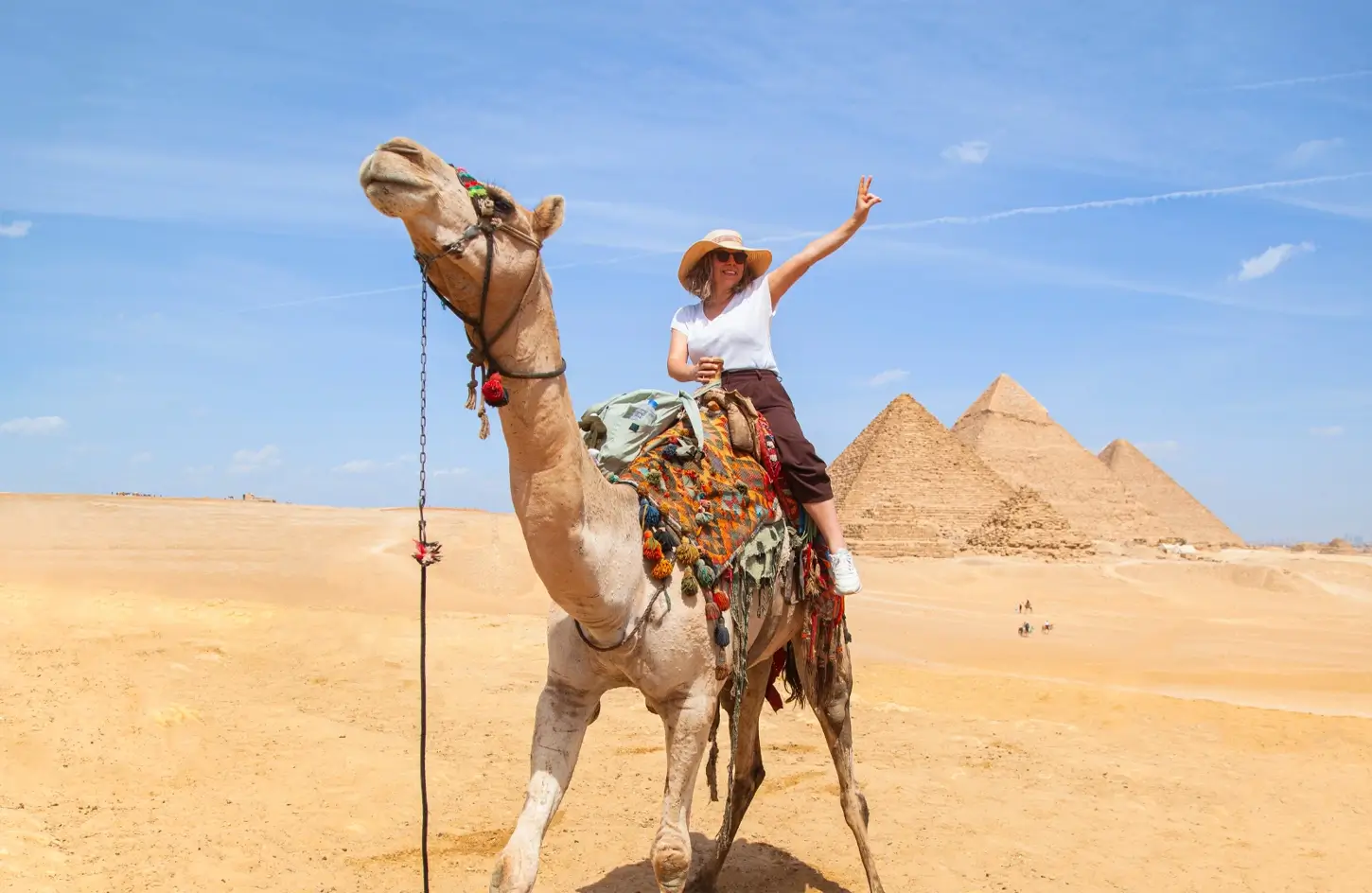
At 6:30 am, before the heat rises and the tour buses arrive, you stand at the base of the Great Pyramid of Khufu. 146 meters of limestone blocks, each weighing between 2.5 and 15 tonnes, assembled with a precision that continues to confound engineers 4,500 years after completion. The morning light is amber. The desert is quiet. The Great Sphinx watches from the east, its limestone face wearing the erosion of millennia with absolute composure.
The Giza Plateau deserves at least 2.5 hours. The three pyramids — Khufu, Khafre, Menkaure — tell different stories at different distances. Walk among them. The Sphinx is smaller than photographs suggest and more powerful than any photograph can capture. The Solar Boat Museum, directly adjacent to the Great Pyramid, houses the 4,600-year-old cedar vessel discovered intact in 1954 — an extraordinary 45-minute detour.
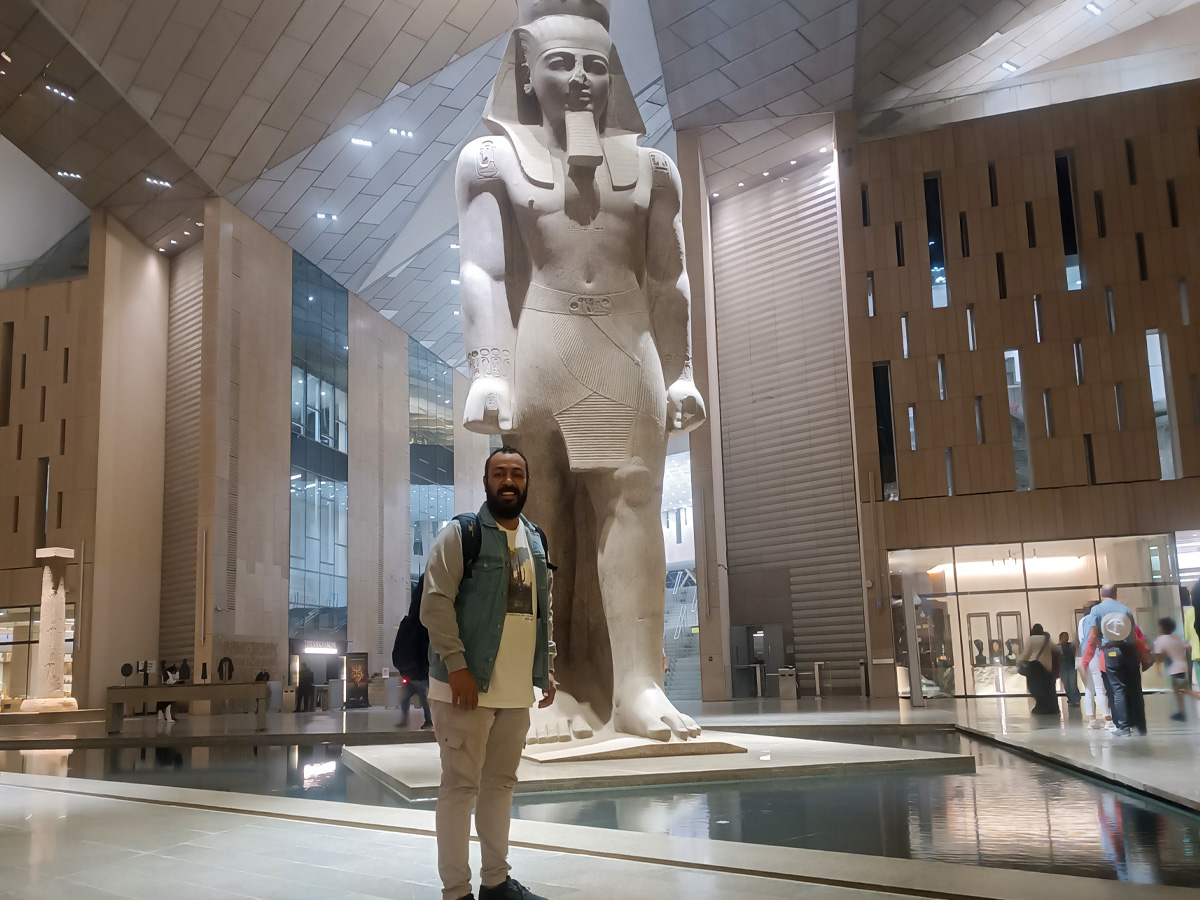
By 9:30 am, you are at the Grand Egyptian Museum, which opened to the public in stages from 2023 and represents the most significant museum construction project of the twenty-first century. The Tutankhamun Galleries contain over 5,000 objects from the boy pharaoh's tomb — including the golden death mask, the golden throne, and the four gilded shrine chambers — arranged in the context of a complete royal life for the first time. Allow 2.5 hours. Book tickets in advance at visit-gem.com; the Tutankhamun galleries regularly sell out.
The afternoon belongs entirely to rest. The Egyptian midday is serious even in October — use it for lunch, the hotel pool, or a nap. Your sites will be there after 4 pm. Your energy will not recover if you burn it in Cairo's midday heat.
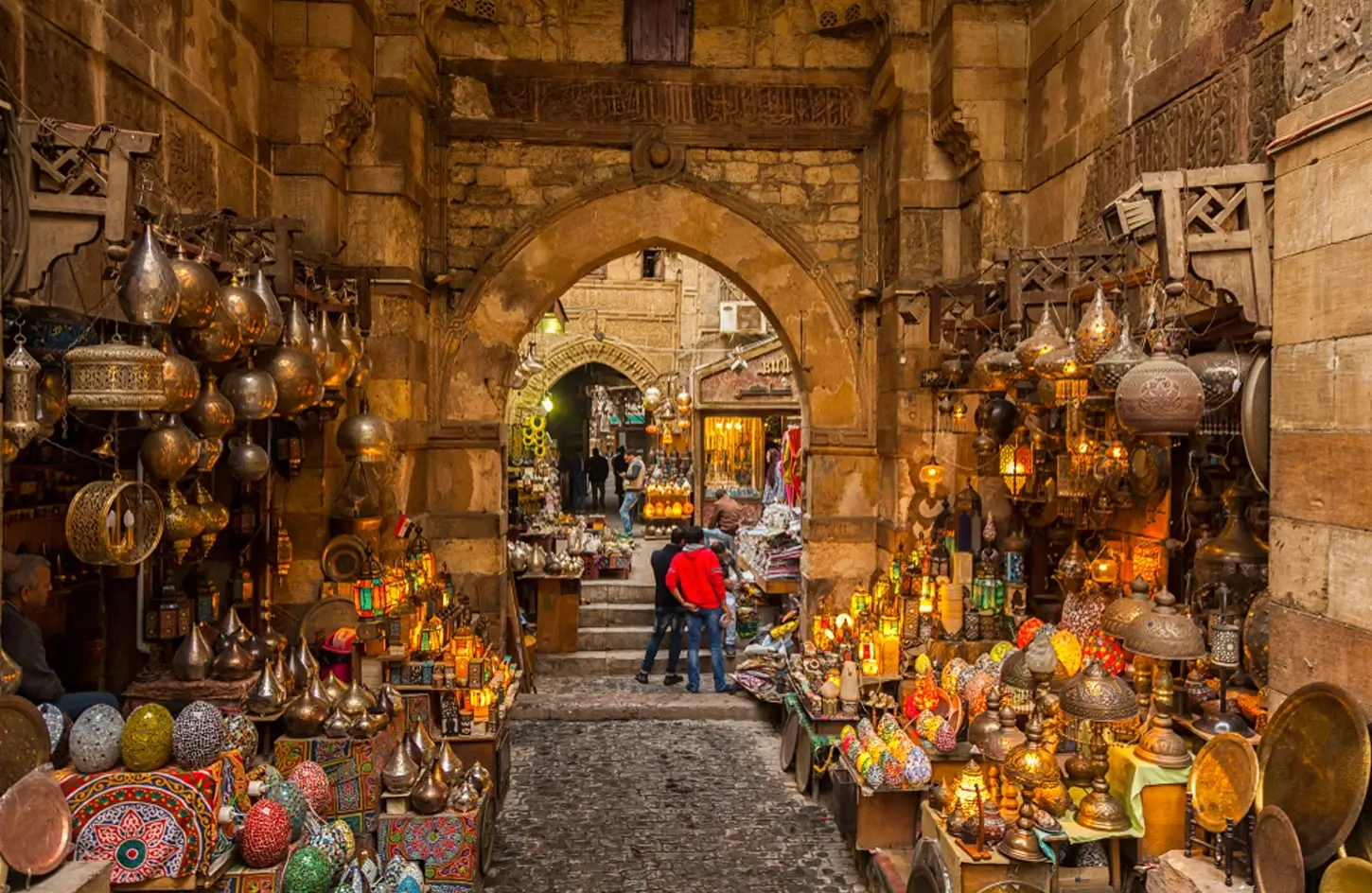
In the evening, take a taxi to Khan el-Khalili — the great medieval bazaar of Islamic Cairo. Have tea at El Fishawy, the coffeehouse that has operated without interruption since 1773. Walk Al-Muizz Street briefly, where Fatimid and Mamluk architecture lines a pedestrian lane under soft evening light. Return to your hotel by 10 pm.
Day 2 is the greatest single historical day most people will ever have. Do not try to add anything else. Let it be exactly what it is.
📷 Image suggestion: Grand Egyptian Museum exterior at dusk, or Tutankhamun's golden mask (official press photo)
💡 GEM Booking Priority Book GEM tickets at least two weeks in advance — the Tutankhamun Galleries sell out on peak days. Request a private Egyptologist guide for the GEM specifically: the sheer density of objects rewards expert interpretation more than almost any other site in Egypt. |
Day 3 — Fly to Luxor: The Temples Begin
The Cairo to Luxor flight takes approximately one hour. As the aircraft descends, the Nile appears below — broader here, calmer, a deep greenish-blue flanked by cultivation and then, abruptly, desert. Luxor from the air looks exactly as it should: a city built along a river, surrounded by ancient stone.
If your energy allows, a brief morning in Islamic Cairo before your midday flight adds something to the day — Al-Muizz Street and the Cairo Citadel are thirty minutes from Giza hotels. But on a five-day schedule, rest and careful packing are equally valid choices. Do not compromise Day 3's afternoon for a rushed half-morning.
After checking into your Luxor hotel, rest through the early afternoon heat. By 3 pm, you are ready for Luxor Temple — one of the finest ancient monuments in the world, built primarily by Ramses II in the 13th century BCE and expanded across five dynasties. In the late afternoon light, the sandstone columns glow warm ochre. By evening, they turn gold.
Stay for darkness. Luxor Temple illuminated at night — the Avenue of Sphinxes lit from below, the hypostyle columns rising 21 meters against a black sky, the Nile reflecting amber light from the corniche — is one of the most beautiful sights in Egypt. Entrance costs approximately 300 EGP. It requires nothing more than a walk from your hotel after dinner and approximately 90 minutes of your evening.
Luxor Temple in the evening is mandatory. Do it tonight — your tomorrow is too full.
📷 Image suggestion: Luxor Temple illuminated at night — sphinxes in foreground, pylons behind
💡 The Luxor Temple Night Rule If I could give five-day travelers one single non-negotiable addition to any standard itinerary, this is it. Most travelers visit Luxor Temple in the morning — do the opposite. The experience of the illuminated temple on the evening you arrive, when Luxor is still completely new, is one you will describe for years. |
Day 4 — West Bank Full Day: The Valley of the Kings
This is the day.
At 6 am, you cross the Nile by private car. The West Bank cliffs warm in the first light, shifting from grey to amber as the sun clears the Eastern Desert. The mountains above the Valley of the Kings are shaped like a natural pyramid — the New Kingdom pharaohs chose this location deliberately, placing their hidden tombs beneath a peak that mirrored the symbol of resurrection.
Your morning covers three West Bank sites. Start early at the Valley of the Kings — your standard ticket covers three tombs, and your guide will advise on which to choose based on what is open that day. The tomb of Ramses VI rewards the extra walk for its breathtaking astronomical ceiling: a complete map of the Egyptian cosmos painted in vivid blue and gold across the burial chamber vault. Allow two full hours for the Valley. Do not rush.
By 8:30 am, drive fifteen minutes south to Hatshepsut Temple — the mortuary temple of Egypt's greatest female pharaoh, set directly against sheer limestone cliffs. The architecture is startlingly modern in its geometry: three colonnaded terraces rising from the desert floor, the cliff face serving as its rear wall. In the early morning light, with the cliffs beginning to warm behind it, the effect is extraordinary. Allow one hour.
A brief free stop at the Colossi of Memnon — the two 18-meter seated statues of Amenhotep III, standing roadside since 1350 BCE — and you return to the East Bank by 10 am. Rest. Lunch. Air conditioning. This is the midday rule, and observing it will completely save your afternoon energy.
By 3 pm, you are at Karnak Temple Complex — the largest ancient religious complex ever constructed, covering 100 hectares and built by successive pharaohs across 1,500 years. The Great Hypostyle Hall: 134 columns, the tallest 23 metres, carved with reliefs in vivid ochre and crimson that have barely faded in 3,200 years. In the late afternoon light, the stone turns the color of honey. Allocate 2.5 hours minimum.
The optional Sound and Light Show at Karnak runs in the evening for those with remaining energy — a theatrical narration through the illuminated complex, corny in the best possible way and genuinely atmospheric.
Day 4 is the Day. Ramses in the morning, Hatshepsut before 10 am, Karnak in the golden afternoon light. This is a day that changes people — and I have guided many hundreds of them through it.
📷 Image suggestion: Valley of the Kings entrance or painted tomb interior ceiling; Karnak Hypostyle Hall at golden hour
💡 The Midday Rule The biggest wasted resource on five-day trips is fighting the afternoon heat. From 11 am to 4 pm, use the time for the Luxor Museum, your hotel pool, or the Grand Egyptian Museum in Cairo. Sites are always better before 10 am and after 4 pm. Your energy is the limiting factor — protect it. |
Day 5 — Luxor Museum + Return to Cairo
On the final Luxor morning, the light across the East Bank is gentle and low. The Nile moves slowly past the felucca boats tied at the corniche, their white sails folded. The West Bank cliffs, which you crossed yesterday before dawn, are just a horizon now — pale and still.
Visit the Luxor Museum before 11 am. It is a small, extraordinarily well-curated collection that puts the Tutankhamun rooms in the Egyptian Museum to shame for presentation. The mummified remains of Ramses I, royal statuary from the New Kingdom, and objects recovered from Karnak's cachette — the great ritual burial of thousands of stone figures discovered in 1903 — are displayed with a clarity and care that gives everything you saw in the temples the human context they deserve.
If your flight allows, spend 45 minutes on a felucca — a traditional wooden Nile sailboat, unhurried, the West Bank cliffs visible across the water, the morning light calm and golden. A natural, unhurried closing to Luxor.
Then: transfer to Luxor Airport for your Cairo connection, or your direct international flight if your routing allows an open-jaw departure from Upper Egypt.
The Luxor Museum is how you close the chapter. Leave Luxor understanding Egypt better than you did when you arrived — that is what it is for.
📷 Image suggestion: Felucca on the Nile with West Bank cliffs in background — dawn or early morning light
Route B — Cairo + Aswan: The Soul of Egypt in 5 Days
Route B is for a different traveler. Not less historically significant — Aswan and Abu Simbel together cover 3,200 years of Egyptian civilization and include one of the most breathtaking architectural achievements of the ancient world. But the pace is more generous. The atmosphere is richer in a different way. Nubia instead of tombs. Feluccas instead of colossal temple complexes. Both are essential to Egypt.
Days 1 and 2 are identical to Route A — Cairo, the Pyramids, the Grand Egyptian Museum, and Khan el-Khalili in the evening. From Day 3, Aswan replaces Luxor.
Day 3: Fly to Aswan instead of Luxor. Arriving mid-afternoon, check in and rest briefly before visiting Philae Temple at golden hour — the sanctuary of the goddess Isis, transported stone by stone to its current island during the UNESCO rescue of the 1970s when the High Dam threatened to submerge it forever. Approach by motorboat. The pink granite rocks, the lotus columns, the Nile light — Philae at dusk belongs to a different time entirely. End the day with a felucca on the Nile as the sun drops behind the West Bank.
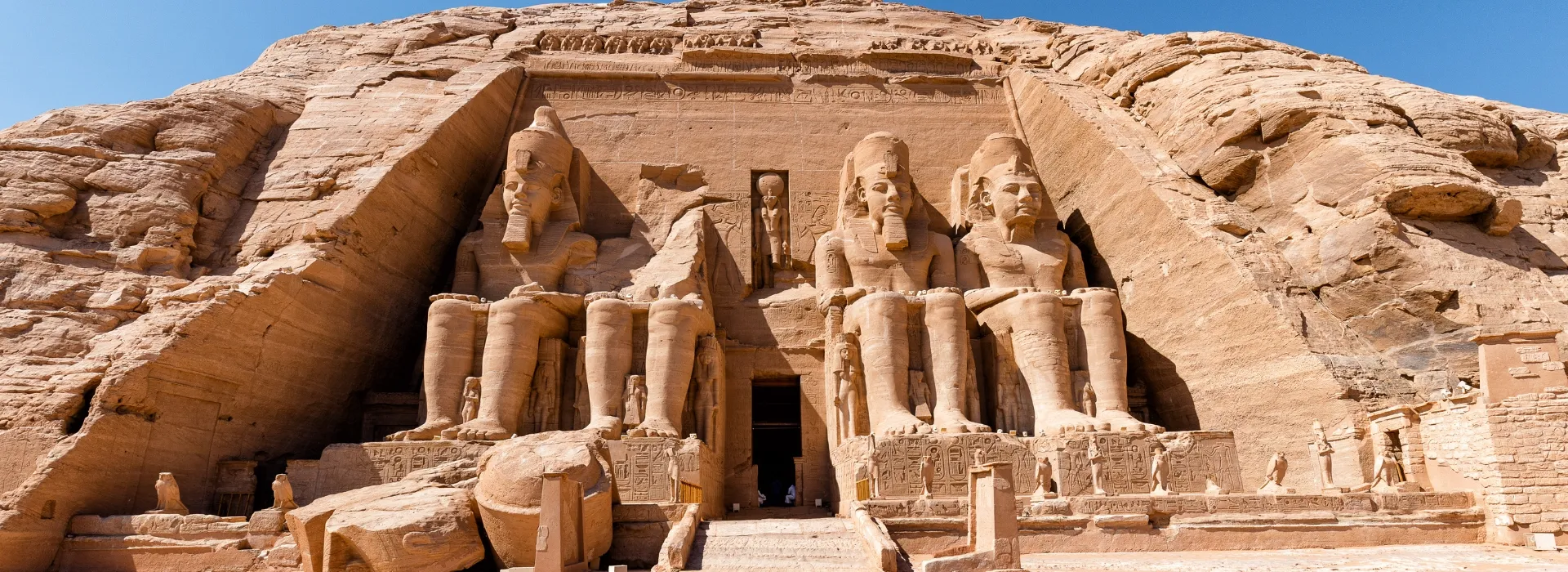
Day 4: The non-negotiable. Take the early morning flight to Abu Simbel — approximately 45 minutes from Aswan Airport, departing around 7am to arrive before the day's heat. The two temples of Ramses II, carved directly into a sandstone cliff above Lake Nasser, are Egypt's most monumental single site: four colossal statues, each 20 metres tall, watching the lake from a façade that has stood for 3,200 years. Return to Aswan by midday. Afternoon: the High Dam, the Unfinished Obelisk (the largest obelisk ever begun, abandoned in the granite quarry when a flaw appeared), and the Nubia Museum — one of Egypt's finest.
Day 5: Elephantine Island by boat, the Aswan Souq for saffron and Nubian spices, a final felucca, then fly home from Aswan or connect back through Cairo.
⚠️ Abu Simbel on a 5-day itinerary only works if you fly from Aswan (45 min each way). The road convoy via the Western Desert (3.5 hours each way) is incompatible with a compressed schedule. Book the Abu Simbel flight at least one week in advance — it operates once or twice daily and fills quickly. |
Route B is for a traveler who wants atmosphere over volume. Nubian culture. The stillness of Lake Nasser. The granite boulders of Aswan are glowing pink at dawn. This is a different Egypt — quieter, older-feeling, and just as essential.
What to Cut — And Why You Won't Regret It
Travelers on five-day Egypt trips make one consistent mistake: trying to do what a ten-day itinerary does, but faster. This makes every day feel rushed, and every site feel incomplete. The five-day traveler's skill is not addition — it is confident subtraction.
Cut these without hesitation:
• Saqqara and Dahshur: The Step Pyramid of Djoser and the Red Pyramid are extraordinary — and they belong to your second Egypt trip. Day 2 belongs entirely to Giza and the GEM. Splitting the day between these sites and Saqqara means doing none of them properly.
• Islamic Cairo as a full half-day: Khan el-Khalili on the evening of Day 2 gives you the bazaar, the architecture, and the atmosphere you need. A full day in Fatimid Cairo belongs to a ten-day itinerary.
• The sleeper train: The Cairo–Luxor overnight train takes twelve hours. On five days, time is your most limited resource. Fly between cities. A domestic flight costs $50–80 and saves a full day of travel.
• Red Sea extension: A Hurghada or Sharm el-Sheik beach day is genuinely incompatible with Cairo and Upper Egypt in five days. If you want both, add three days to your trip or book the beach separately.
Keep at all costs:
• The Valley of the Kings (at least 3 tombs)
• The Karnak Temple Complex (2.5 hours minimum)
• The Tutankhamun collection at the Grand Egyptian Museum
• The Pyramids of Giza at opening time
• Philae Temple or Abu Simbel (Route B)
• Luxor Temple at night (Route A)
On five days, every hour is essential. Commit to the scope completely. What you cut is not lost — it is deferred. And every client who returns to Egypt for a second trip tells me they enjoyed the first trip more once they stopped trying to see everything.
Practical Planning Notes for 5 Days
Booking Timeline
The biggest planning mistake on five-day trips is leaving domestic flights too late — Cairo–Luxor and Cairo–Aswan routes are popular year-round, and flexible seats disappear six to eight weeks out.
When | What to Book |
3–6 months ahead | International flights — open-jaw preferred (Cairo in / Luxor or Aswan out) |
6–8 weeks ahead | Domestic flights (Cairo–Luxor or Cairo–Aswan) |
3–4 weeks ahead | Egypt e-Visa at visa2egypt.gov.eg |
2–3 weeks ahead | GEM tickets at visit-gem.com + hotel bookings for all nights |
1 week ahead | Abu Simbel flight from Aswan (Route B) or private guide/tour booking |
Which Cairo Neighborhood for 5 Days?
Giza is the correct choice for five-day trips — without qualification. Proximity to the Pyramids saves 40 minutes of Cairo traffic on Day 2 morning, and on a compressed schedule, that 40 minutes represents a meaningful portion of golden-hour time at the Giza Plateau.
The Marriott Mena House sits directly at the foot of the Pyramids and offers breakfast with a Great Pyramid view that belongs on any traveler's lifetime list. Mid-range and budget options along the Pyramids Road are equally well-positioned for the same geographic advantage.
Downtown Cairo hotels offer easier access to Islamic Cairo sightseeing, but add meaningful transit time to your most important morning. On five days, optimize for Day 2.
Open-Jaw Flights — The 5-Day Traveler's Secret
If your airline routing allows it, fly into Cairo International Airport and home from Luxor Airport or Aswan Airport. This eliminates one domestic return flight and one transit back to Cairo — saving both money and several hours of travel time on your final day.
Most major carriers (EgyptAir, Emirates, Qatar Airways, Turkish Airlines) offer open-jaw routing at minimal or zero fare premium over standard return ticketing. Search for this specifically when booking. For Gulf market travelers flying EgyptAir from Cairo, open-jaw routings through Luxor or Aswan are particularly well-priced.
Fly into Cairo and home from Luxor. On a five-day trip, this is a significant saving of both money and time — and it gives your last morning in Luxor a completely different feeling.
The 5-Day Gulf Market Edition — Special Notes
I guide dozens of families from the UAE and Saudi Arabia on exactly this five-day format every year, and I want to address the Gulf market specifically — because almost no travel guide does.
Egypt's proximity to the Gulf makes the five-day format its most natural trip length. From Dubai or Abu Dhabi, direct EgyptAir and flydubai flights reach Cairo in approximately 3.5 to 4 hours. From Riyadh or Jeddah, direct flights take 2 to 3 hours. From Kuwait City or Manama, flight times are similar. This positions Egypt as one of the most accessible long-weekend international destinations from anywhere in the GCC.
Five-day trips align naturally with Eid holidays, UAE National Day, school half-terms, and GCC long weekends. The Cairo + Luxor format fits a Thursday departure / Monday return schedule with no friction.
Gulf nationals — UAE, Saudi Arabia, Kuwait, Bahrain, Qatar, Oman — enter Egypt visa-free for 90 days. No advance application, no visa-on-arrival queue, no appointment required. Arrive, clear passport control, done.
Recommended GCC-specific logistics:
• Search EgyptAir, flydubai, Air Arabia, and Emirates for direct Cairo routes
• Book Cairo hotels in Giza (Marriott Mena House, Le Méridien Pyramids, or Hilton Pyramids Golf)
• Book the domestic flight Cairo–Luxor before departing the GCC.
• Private guide and car in both Cairo and Luxor is strongly recommended for Gulf families — eliminates every logistics decision
• Ramadan travel note: sites remain open throughout Ramadan, though hours occasionally shift — confirm in advance
Five days in Egypt is the natural trip length for the Gulf market. You return home on Sunday night, having stood inside the Valley of the Kings and seen the complete treasure of Tutankhamun. That is not a compromise. That is one of the finest five-day travel experiences in the world.
Frequently Asked Questions
Is 5 days enough to see Egypt?
Five days are enough to see Egypt's two most important experiences: Cairo (the Pyramids and the Grand Egyptian Museum) and either Luxor (the Valley of the Kings, Karnak, Hatshepsut) or Aswan (Philae, Abu Simbel, Nubian culture). It won't cover all of Egypt — no trip does — but it delivers the essential historical experience at a pace that leaves every day full without being frantic.
What is the best 5-day Egypt itinerary?
Route A (Cairo + Luxor) is recommended for most first-timers: Day 1 arrival in Cairo, Day 2 Pyramids and GEM, Day 3 fly to Luxor and visit Luxor Temple in the evening, Day 4 West Bank full day (Valley of Kings, Hatshepsut, Karnak), Day 5 Luxor Museum and fly home. Route B substitutes Aswan for Luxor, adding Abu Simbel on Day 4 via the early-morning flight — ideal for travelers who want the Nubian experience and Egypt's most monumental single temple.
Can I fly from Dubai to Egypt for 5 days?
Yes — this is one of Egypt's most natural short-trip formats. EgyptAir, flydubai, and Emirates operate direct routes from Dubai to Cairo; flight time is approximately 3.5 to 4 hours. Gulf nationals (UAE, Saudi Arabia, Kuwait, Bahrain, Qatar, Oman) enter Egypt visa-free for 90 days — no pre-booking required. A five-day Cairo + Luxor trip is entirely achievable from Dubai and is the guide's top recommendation for the UAE market.
Should I do Cairo only for 5 days?
Cairo alone for 5 days is viable if your primary interests are Islamic architecture, Coptic history, and the Egyptian Museum collections — adding Saqqara, Dahshur, the Coptic quarter, and full Islamic Cairo to GEM and the Pyramids fills five days well. But missing Luxor means missing half of Egypt's essential historical story. Unless you have a specific Cairo-focused reason, the guide recommends at least one domestic flight to Luxor or Aswan.
How much does a 5-day Egypt trip cost?
Approximately $800–1,200 per person at budget level, $1,500–2,500 mid-range, or $4,000–8,000+ luxury — excluding international flights. Key costs: 1–2 domestic flights ($120–200), accommodation for 4 nights ($120–600 depending on tier), entrance fees across all sites (approximately $160 total), private guides for key days ($400–800), and the Abu Simbel flight if doing Route B ($80–120).
What are the must-sees in 5 days in Egypt?
Non-negotiable for any 5-day Egypt trip: Pyramids of Giza and Great Sphinx (2.5 hours), Grand Egyptian Museum / Tutankhamun Galleries (2.5 hours), Valley of the Kings in Luxor (2 hours minimum), Karnak Temple Complex (2.5 hours), and either Luxor Temple at night (Route A) or Abu Simbel by early morning flight (Route B). Every other site is secondary on a five-day schedule.
Ready to Plan Your 5 Days in Egypt?
The itinerary is clear. The route is decided. What remains is the booking — and the first morning at the Pyramids, which will be nothing like you imagined and better than you hoped.
If you want to plan your five days with a guide who has been doing exactly this for fifteen years, message me directly. No itinerary is one-size-fits-all — a five-day Gulf family trip looks different from a solo European traveler's route, and both look different from a UAE couple's anniversary journey. I will plan yours specifically.
📲 Ready to Plan Your 5 Days in Egypt? Message Magdy directly on WhatsApp — free itinerary advice, no obligation. |