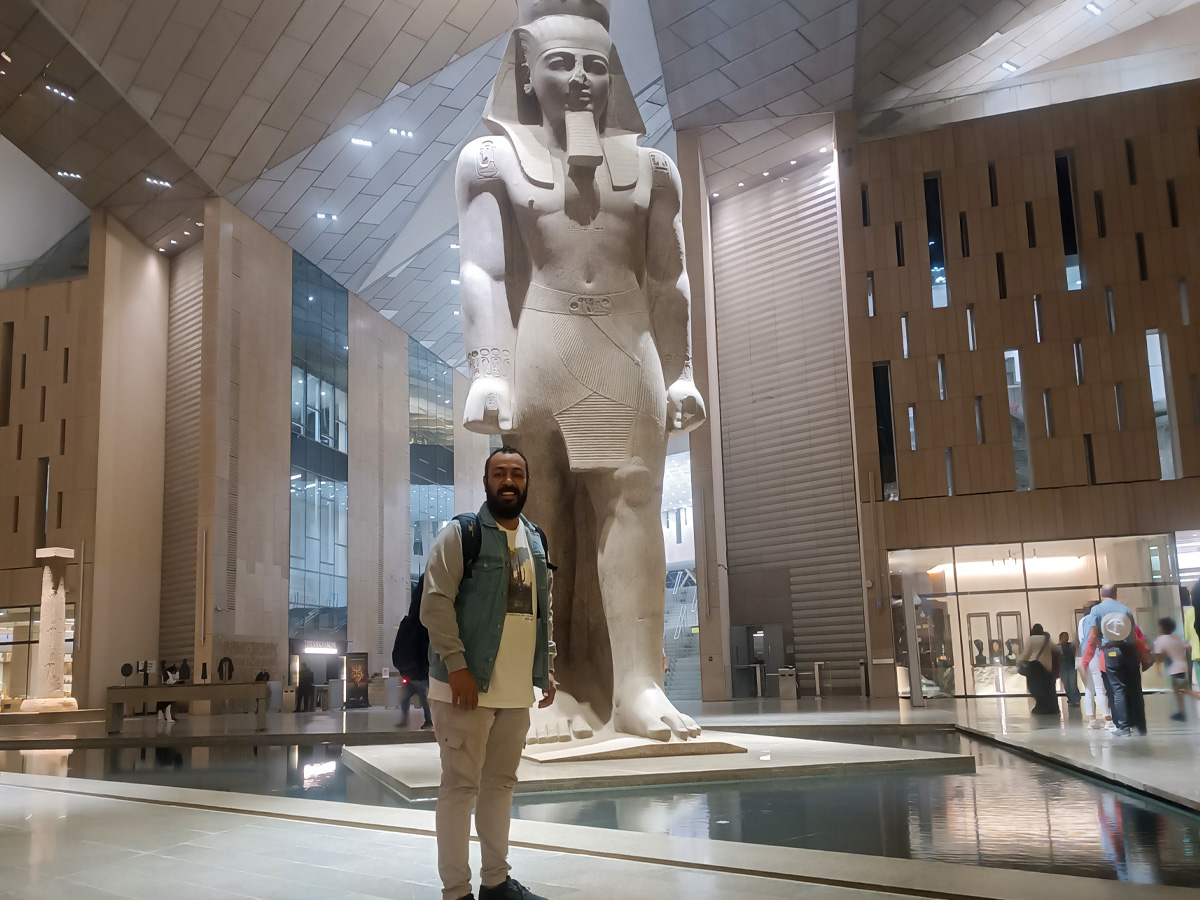
There is a moment at Abu Simbel — it happens as you round the last bend of the approach path — when the temples appear without warning.
Four figures. Twenty meters tall each. Carved from solid rock. Seated, hands on their knees, staring across the desert and the lake in an expression that is neither anger nor peace but something in between — absolute permanence.
I have guided visitors through Egypt for fifteen years, and I have witnessed this moment hundreds of times. Without exception, every single person stops walking. Most of them go quiet. Some of them cry.
This is not a sightseeing experience. Abu Simbel is a confrontation with the scale of human ambition across 3,200 years — and then, when you learn that the temples were dismantled and moved entirely to save them from a dam, with the scale of modern human determination to protect what was built.
The journey is long. The departure time is unreasonable. The heat is significant. Go anyway. This guide will tell you exactly how to visit Abu Simbel, which transport to choose, what the tickets cost, and when the solar alignment makes the already extraordinary, genuinely unforgettable.
Key Takeaways — How to Visit Abu Simbel
Fly (recommended) or drive: Fly from Aswan in 45 minutes ($80–150pp) for efficiency, or take the road convoy at 5 am (3.5 hrs each way) for the Sahara experience. First-timers: fly.
Depart early: Fly pre-7 am or join the 5 am road convoy to arrive before heat and tour group crowds build after 8:30 am.
Tickets at the gate: No advance booking needed. Approximately 615 EGP adult (both temples). Card payment only.
Guides cannot enter: All tour guide commentary happens outside the temples. Ask every question before you enter.
The Sun Festival is extraordinary: February 22 and October 22. Book transport 3+ months ahead. Premium ticket price applies.
Allow 2–2.5 hours at the site: 45–60 min at the Great Temple + 30–40 min at the Nefertari Temple + 20 min for the lake view and the approach.
Overnight is the premium option: Sound & Light Show in the evening + dawn visit before day-trippers arrive. The best upgrade available on any Egypt itinerary.
Why Abu Simbel Stops People Cold
Before the logistics — before we discuss flights, tickets, and departure times — let me tell you what you are actually going to see, because no amount of practical information prepares you for the emotional reality of this place.
Abu Simbel consists of two rock-cut temples carved directly into a sandstone cliff on the western bank of Lake Nasser in Egypt's southernmost corner, near the Sudanese border. The temples were commissioned by Ramesses II around 1264 BCE — during a reign so long and so prolific that its monuments continue to define the visual vocabulary of ancient Egypt three thousand years later. But even among Ramesses' extraordinary building program, Abu Simbel stands apart.
The Great Temple of Ramesses II announces itself with four colossal seated statues of the pharaoh, each standing 20 meters tall, guarding the facade in an unbroken line of authority. Scale is not something photographs communicate well. Photographs tell you the statues are large. Standing in front of them tells you something different — that you are small, that stone endures, and that whoever commissioned this understood exactly what they were doing with both facts.
Adjacent to it, the Temple of Nefertari — built by Ramesses in honor of his most beloved queen — is smaller in scale but arguably more startling in meaning. It was rare, bordering on unprecedented, for an Egyptian pharaoh to dedicate a temple to his wife rather than himself. On its facade, the colossi of Nefertari stand at the same height as those of Ramesses — an architectural declaration of equality that reads as radical even by modern standards.
But the story that most visitors find transformative is not ancient — it happened within living memory. In 1964, the construction of the Aswan High Dam threatened to submerge the temples permanently beneath the rising waters of what would become Lake Nasser. UNESCO coordinated one of the most extraordinary engineering operations in modern history: the entire complex was dismantled into 1,036 individual blocks, each weighing up to 30 tonnes, and reassembled 65 meters higher on an artificial hill — and the ancient solar alignment still works.
That solar alignment: twice a year, on February 22 and October 22, sunrise sends a shaft of light penetrating 60 meters down the temple's main corridor and illuminating three of the four statues in the innermost sanctuary — Amun-Ra, Ramesses II, and Ra-Horakhty. The fourth statue, Ptah, god of darkness, remains in shadow. Ancient engineers designed this 3,200 years ago. Modern engineers relocated it. And it still works, to the minute.
The first time I stood at the entrance of Abu Simbel at dawn, watching the floodlights warm the four statues from dark to gold, I understood why this was the reason people cross the Sahara. There is no preparation that is adequate for this.
📸 Media Suggestion Hero image: Wide-angle shot of all four Ramesses II colossi at sunrise, with a single human figure at base for scale. Alternatively: aerial photograph of both temples with Lake Nasser visible behind — the blue-gold contrast is extraordinary. |
| |
= | ||
Getting There — Fly or Drive?
The single most common question I'm asked about Abu Simbel is how to get there from Aswan. The answer depends on what kind of traveler you are, how much time you have, and what you want the experience to include — because the journey itself is part of the story, whichever option you choose.
Abu Simbel is approximately 280 kilometres south of Aswan along the western shore of Lake Nasser. There are three realistic options: fly, drive (private car or group tour), or stay overnight. Here is everything you need to know about each.
Option 1 — Fly from Aswan (Recommended for Most Travelers)
EgyptAir operates daily scheduled flights between Aswan International Airport and Abu Simbel Airport — a journey of approximately 45 minutes in the air. It is the fastest and most time-efficient way to visit Abu Simbel as a day trip, and it is the option I recommend to most first-time visitors on a standard Egypt itinerary.
The door-to-door reality on a fly day: allow 5–6 hours total, including airport transfers in Aswan, the flight, approximately 2–2.5 hours at the temple site, and the return flight. You can be back in Aswan by midday, with the afternoon free for Aswan sightseeing — the Philae Temple, the Nubian Museum, a felucca at sunset. It is efficient without feeling rushed.
EgyptAir provides a complimentary shuttle bus between Abu Simbel airport and the temple complex — take it. The temples are a short drive from the airport and the bus drops you at the entrance. Book flights through EgyptAir.com or through your Aswan hotel or tour operator. In peak season (October through April), book at least 1–2 weeks ahead — the planes are small and fill quickly.
• Flight time: ~45 minutes Aswan ↔ Abu Simbel
• Cost: approximately $80–150 per person round trip (seasonal variation)
• Frequency: 1–2 flights per day depending on season
• Book via: EgyptAir.com or your Aswan hotel/tour operator
• ⚠️ Important: Flights occasionally cancel due to weather or low passenger numbers. Always have a backup plan — know your road convoy option as a fallback.
💡 Insider Tip — Fly Early Always book the earliest available morning flight. Arriving at Abu Simbel by 7am means 45–60 minutes of relative quiet before the road convoy groups arrive from Aswan. The temples in that early light, with almost no other visitors, are a different experience entirely from the mid-morning crowds. |
Option 2 — Road (Private Car or Group Tour)
The Aswan–Abu Simbel desert road runs approximately 280km south along the edge of Lake Nasser through one of the most beautifully empty landscapes in Egypt. The drive takes 3–3.5 hours each way, and because the road operates under a police convoy system for security, all tourist vehicles must join a scheduled convoy that departs Aswan at 5:00 am. Your driver handles the convoy arrangement — all you need to do is bring your passport and be at the meeting point on time.
At 5 am, driving south from Aswan into the desert dark, with the windows down and the temperature not yet impossible, that drive has a quality I can't fully describe. The absence of everything except sand, sky, and the road ahead. Two hundred and eighty kilometers of the oldest landscape on earth. |
The road option makes for an exceptionally long day — you're looking at 9–10 hours total, with departure at 4am to reach the convoy. But the Sahara landscape between Aswan and Abu Simbel is genuinely stunning in the early morning light: dunes rolling down to the lake's edge, the occasional flash of blue water between golden banks, the silence of a desert that stretches uninterrupted to Sudan. For travelers who want the full desert experience, or who cannot get a flight, it is genuinely worthwhile.
Distance: ~280km south of Aswan
Convoy departure: 5:00 am from Aswan (arrive meeting point by 4:30 am)
Private car cost: approximately $80–150 per vehicle (good for groups)
Group tour cost: approximately $40–70 per person (transport + guide + entry in some packages)
Road hours: Open 5 am to 5 pm — no tourist vehicles outside convoy times
Option 3 — Overnight Stay in Abu Simbel
If there is one recommendation I make to every traveler with the flexibility and budget to follow it, it is this: spend a night in Abu Simbel. The town is small and quiet, the accommodation options are limited but comfortable, and what you gain in exchange for the extra night is difficult to overstate.
The Sound & Light Show — a dramatic projection and narration sequence on the temple facade — runs each evening and provides an entirely different experience of the temples at night: illuminated in shifting colors against the darkness, the four colossi become something genuinely cinematic. Tickets are separate from daytime entry. The primary accommodation option near the site is the Azal Lagoons Resort, a lakeside property with Lake Nasser views — modest by Cairo standards, extraordinary in context.
If you can afford one extra night in Egypt, spend it at Abu Simbel. The dawn visit before any day-trippers arrive is the closest thing I know to having the temples to yourself. The light at 5am on those four faces — it is everything. |
Quick Transport Comparison
Option | Journey Time | Cost (approx.) | Pros | Cons |
✈️ Fly from Aswan | 5–6 hrs total | $80–150 pp | Fast & efficient; complimentary airport bus | 1–2 flights/day; occasional cancellations |
🚗 Private car | 9–10 hrs total | $80–150/car | Sahara landscape; flexible stops | Long day; 4am start |
🚌 Group tour | 9–10 hrs total | $40–70 pp | Budget-friendly; guide included | Fixed schedule; crowded bus |
🌙 Overnight stay | 2 days | $150+ hotel | Sound & Light Show + peaceful dawn visit | Extra cost and night away |
📸 Media Suggestion Infographic: Side-by-side route map showing Aswan → Abu Simbel by air (45 min) vs. by road (3.5 hrs). Include convoy meeting time and convoy route on the road version. Clean travel-magazine aesthetic. |
What to Expect at Abu Simbel — The Site Itself
Most travel guides describe Abu Simbel in the order in which it was built or in the order an art historian might approach it. I am going to describe it in the order you will actually experience it — because that sequence matters, and knowing what is coming helps you be fully present for each moment.
The Approach — First Sight
From the car park or the airport bus drop-off, the temples are not visible. A short landscaped pathway curves around a man-made hill, and as you follow it, the sight of the temples is deliberately withheld. This was not accidental. The approach was designed as part of the original experience — the revelation is meant to be sudden.
The design is deliberate. The path is curved so you cannot see the temples until you round the final bend. And then — they are simply there. Four figures, 20 metres tall, staring across the desert and the lake. The effect of this sudden revelation has not diminished in any of the hundreds of times I have experienced it. |
My advice: when the temples appear, stop where you are. Resist the impulse to immediately move closer or reach for your phone. Stand at the distance of first sight for two full minutes. Allow the scale to register. The temples will still be there when you move closer — but the moment of first seeing them cannot be recaptured.
The Great Temple of Ramesses II
You enter the Great Temple between the legs of the second colossus. Inside, the Hypostyle Hall opens into a forest of eight Osiris-form pillars of Ramesses II, the ceiling painted with astronomical scenes in colors that — given they have survived 3,200 years — remain astonishingly vivid. The walls document Ramesses' military campaigns in elaborate relief, including the Battle of Kadesh — the most extensively narrated military engagement in ancient Egyptian art, covering the pharaoh's confrontation with the Hittites in what may be the world's oldest surviving peace treaty story.
Moving deeper into the temple, you pass through a series of smaller halls and antechambers until you reach the innermost sanctuary — a chamber 60 metres from the entrance. Four seated statues occupy the rear wall: Amun-Ra, Ramesses II, Ra-Horakhty, and Ptah. On the solar alignment dates (February 22 and October 22), sunlight illuminates the first three while Ptah — god of darkness — remains in shadow. Even on an ordinary day, standing in this room with the knowledge of what happens here twice a year is a particular kind of quiet.
Time to allow: 45–60 minutes inside the Great Temple
Photography: Mobile phones permitted (no flash). DSLR/tripod requires a separate photography pass (~300 EGP)
⚠️ Important: Tour guides cannot enter the temples — all commentary happens outside. Ask every question before you go in.
💡 Insider Tip — The Photography Rule Tour guides are prohibited from entering the temples. What this means practically: have your full conversation with your guide outside before you enter. Many experienced guides carry detailed photo books of the interior to walk you through what you're about to see. Once inside, you move through the space alone — which is, once you accept it, actually quite beautiful. Come prepared to read the panels, and take your time. |
The Temple of Nefertari
The Temple of Nefertari is smaller than the Great Temple, but many visitors find it the more emotionally affecting of the two. Its facade presents six colossal standing figures — four of Ramesses II and two of Queen Nefertari — and the queen's statues stand at exactly the same height as the king's. This equality of representation in stone is so unusual in ancient Egyptian royal art that scholars continue to debate its precise meaning. What it communicates visually, without any scholarly apparatus, is something like love made permanent in sandstone.
Inside, the walls and pillars carry some of the finest surviving painted decoration in all of Egypt — vivid scenes of Nefertari in the company of the gods, celebrating her divine nature in colours that range from deep turquoise to warm ochre to a blue so intense it seems lit from within. Allow 30–40 minutes here, and do not rush it.
The Temple of Nefertari is the one that surprises people. They came for Ramesses. They leave talking about Nefertari. |
Lake Nasser Views
After both temples, walk to the terrace behind and turn to face the water. Lake Nasser stretches south toward Sudan — 550 kilometres of reservoir created by the Aswan High Dam, one of the largest artificial lakes in the world. The landscape is arresting: the blue of the lake against the gold of the desert, the utter silence, the absence of any human structure between you and the horizon.
| People always ask me what's behind the temples. The answer is: Sudan, eventually. And between here and there — nothing but water and desert. It's one of the loneliest and most beautiful views I know. | |
📸 Media Suggestion Short video (30–60 sec): Walking the approach path in real time — ending with the temples' first reveal around the final bend. No voiceover. The reaction of a first-time visitor is more powerful than any narration. |
| |
Tickets — What You Need to Know
Abu Simbel has no advanced online booking system — tickets are purchased at the gate on arrival. The ticket office accepts card payments only (no cash), so bring a backup card. There is no separate entry for the Great Temple and Temple of Nefertari — the single ticket covers both sites.
Visitor Type | 2026 Fee (approx.) | Notes |
Adult (foreign visitor) | ~615 EGP | Both temples |
Student (ISIC card) | ~308 EGP (50% off) | Both temples |
Sun Festival dates | ~1,200 EGP | Feb 22 & Oct 22 only |
Photography pass (DSLR) | ~300 EGP extra | No flash at any time |
Opening hours: 5:00 am – 6:00 pm daily (subject to seasonal and Ramadan adjustments — verify locally before travel)
No advance booking required: tickets purchased at the gate on arrival
Payment: card only at the ticket office — bring a backup card
⚠️ Writer Note: Verify current fees before publishing — Egyptian temple admission prices have increased significantly in recent years and are subject to change.
The Sun Festival — Is It Worth Timing Your Visit?
Twice a year — February 22 and October 22 — something happens inside the Great Temple that has been happening, with minor interruption, for approximately 3,200 years. At sunrise, light enters the 60-meter corridor and reaches the innermost sanctuary, illuminating the three divine and royal statues on the rear wall — Amun-Ra, Ramesses II, and Ra-Horakhty — while Ptah, the god of darkness, remains untouched by the light. The event lasts approximately 20 minutes.
The original dates are believed to have been February 21 and October 21 — Ramesses' coronation and birthday, according to some interpretations — but the temple's relocation shifted the alignment by one day. What ancient engineers designed millennia ago, what UNESCO engineers successfully preserved during the 1964–68 operation, continues to function with precision that is, frankly, astonishing.
I have been at Abu Simbel on both Sun Festival dates. The moment the light crosses the sanctuary and touches Ramesses' face, the crowd goes completely silent. Whatever cynicism you arrived with is gone. It is one of those experiences that does not perform as described. It exceeds it. |
The crowd reality: The Sun Festival draws hundreds of visitors specifically for the event. Buses arrive from Aswan in the pre-dawn dark. There is a festival atmosphere — genuinely celebratory and often emotional — but it is not quiet, and the sanctuary is crowded during the alignment. This does not diminish the experience for most visitors. But it is different from an ordinary day.
💡 Insider Tip — The Day-Adjacent Option If you want something closer to the solar alignment experience without the full festival crowds, consider visiting on February 21 or February 23 — the days adjacent to the main festival. The sun enters the corridor at a near-identical angle on these dates, and the site will be significantly quieter. You won't have the full 20-minute illumination — but you'll have something closer to silence, which has its own value. The choice between perfection and solitude is one only you can make. |
Verdict: Yes, the Sun Festival is worth timing your visit for if your schedule allows it. Book all transport and accommodation at least 3 months in advance for these dates — the demand is genuine, and availability goes quickly. Factor the premium ticket price (~1,200 EGP) into your travel budget.
Practical Tips from the Guide
These are the things I wish someone had told me on my first visit — and the things I now tell every traveler I take to Abu Simbel.
• Bring your own water and snacks. Facilities at Abu Simbel are limited, and what is available is expensive. Fill up in Aswan — bring at least 2 liters of water per person for a summer visit; 1.5 liters in the cooler months. A few snacks for the return journey are also a good idea.
• Use the golf cart. A small electric cart operates between the entrance and the temple complex for a modest fee. In July or August, the walk in direct sun is unpleasant, and the cart is worth every pound. It is also useful for visitors with limited mobility.
• Shade is scarce — dress for the sun. A wide-brimmed hat, UV-protective sunglasses, and high-SPF sunscreen are non-negotiable at any time of year. The site has very limited natural shade.
• Arrive before 9 am. Tour groups from Nile cruise ships typically arrive between 8:30 am and 10 am — making mid-morning the busiest period by far. The first hour after opening is significantly more peaceful.
• Budget for the photography pass. If you are bringing a DSLR or mirrorless camera, the ~300 EGP photography pass is worth the cost. Mobile phones are permitted without an additional fee — but professional equipment requires the pass. No flash is permitted under any circumstances inside either temple.
• The afternoon secret (overnight visitors only). Most day-trippers leave by noon. If you are staying overnight, an afternoon visit — after 1 pm, when the site is nearly empty — is a completely different experience from the morning rush. The light is high and golden, the silence is profound, and the Lake Nasser views from the terrace are extraordinary.
• For families with children. Abu Simbel is a genuinely engaging site for older children (10+) who have some context for ancient Egypt. The scale of the colossi alone is arresting — children often respond to the sheer size in a way that adults, guarded by self-consciousness, sometimes don't. Carry water, apply sunscreen before you arrive, and use the cart if needed.
Planning Your Abu Simbel Visit in Context
Abu Simbel works best as a day trip from Aswan — either by flight (the most efficient option) or by road convoy (the more atmospheric one). In the context of a 10-day Egypt itinerary, Abu Simbel typically falls on Day 4, after two days in Aswan. In the context of a 7-day itinerary, it is logistically tight but achievable with a 7am flight — combining it with Aswan sightseeing in the same day.
The classic and most satisfying day structure for fly visitors: early morning flight to Abu Simbel → 2–2.5 hours at the site → return flight to Aswan by midday → afternoon at the Philae Temple or along the Nile. This leaves you with a full and memorable day without feeling rushed at either end.
For those with the time for an overnight stay, Abu Simbel deserves two days — an evening for the Sound & Light Show and the quiet of the town after day-trippers leave, and a morning for the dawn visit before anyone else arrives. The extra night is the best upgrade available on a standard Egypt itinerary, and the cost is modest by any international travel standard.
🔗 Internal Links for Readers Things to Do in Aswan → Post #9 Egypt Itinerary 10 Days → Post #5 Egypt Itinerary 7 Days → Post #14 Best Time to Visit Egypt → Post #1 Egypt in Summer (heat planning context) → Post #16 |
Frequently Asked Questions About Visiting Abu Simbel
How long does it take to get from Aswan to Abu Simbel?
By plane: approximately 45 minutes in the air, 5–6 hours door-to-door, including airport transfers and time at the site. By road: approximately 3–3.5 hours each way in a private car or group tour, with a mandatory security convoy departure. A full-day trip by road takes 9–10 hours total.
Can you visit Abu Simbel as a day trip from Aswan?
Yes — both the flight option and the road option work as day trips from Aswan. The flight is more time-efficient (5–6 hours total), while the road option provides a full-day experience (9–10 hours) with the added dimension of crossing the Sahara by desert road. An overnight stay is also possible and allows for the Sound & Light Show and a peaceful dawn visit before day-trippers arrive.
How much is the entrance fee for Abu Simbel in 2026?
Approximately 615 EGP for adult foreign visitors — a single ticket covering both the Great Temple and the Temple of Nefertari. Students with an ISIC card receive a 50% discount. On Sun Festival dates (February 22 and October 22), tickets are subject to a premium rate of approximately 1,200 EGP. All tickets are purchased at the gate; card payment only. Fees are subject to change — verify current prices before travel.
What is the Abu Simbel Sun Festival?
Twice a year — February 22 and October 22 — sunlight enters the Great Temple's 60-meter corridor and illuminates three of the four sanctuary statues (Amun-Ra, Ramesses II, and Ra-Horakhty), while Ptah, god of darkness, remains in shadow. The alignment was deliberately engineered by ancient builders approximately 3,200 years ago and survived the temple's relocation intact. The phenomenon lasts approximately 20 minutes and draws large crowds — book all transport and accommodation at least 3 months in advance for these dates.
Is it worth going to Abu Simbel?
Without qualification: yes. Abu Simbel is, alongside the Pyramids of Giza, the most monumentally impressive ancient site in Egypt — and for many visitors, the more emotionally powerful of the two. The scale of the Great Temple facade, the extraordinary interior paintings, the story of the UNESCO relocation, and the surviving solar alignment combine to create one of the world's defining travel experiences. The distance from Aswan makes it logistically demanding. It is worth every early morning departure.
Can Abu Simbel be visited from Luxor?
Not practically as a day trip — the distance and connection requirements make a Luxor–Abu Simbel–Luxor return in one day excessive and exhausting. The standard approach is to visit Abu Simbel as part of an Aswan stay. Travel from Luxor to Aswan first (by road, train, or Nile cruise), then do Abu Simbel as a day trip or overnight from Aswan.
What is the best time of year to visit Abu Simbel?
October through April offers the most comfortable temperatures for the desert site and the road journey — mornings are cool, afternoons mild. July and August are extremely hot, requiring early-morning visits and additional water. The Sun Festival dates (February 22, October 22) are the busiest single days of the year. For a balance of good weather and manageable crowds, November and March are consistently excellent months to visit.
Ready to Visit Abu Simbel? Our Egypt travel specialists handle flights, road transfers, overnight stays, and Sun Festival bookings — all arranged so you arrive without stress and leave with the experience of a lifetime. 📱 WhatsApp us: +20 100 213 5997 | wa.me/201002135997 |
The temples were built to last forever. They were dismantled to be saved. They were reassembled — 65 metres from where they stood — and the light still enters on the same mornings it always did. Whatever you make of ancient history, of monumental ambition, of the human impulse to protect what is irreplaceable — Abu Simbel will give you something to think about on the long journey home. And probably for some time after that.
— Magdy Fattouh, Egypt Tailored Tours | Egypt Tailored Tours.com