The first thing Cairo does is overwhelm you.
The traffic. The noise. The sheer size of it — 22 million people moving through a city that has been continuously inhabited for over 5,000 years. The call to prayer echoing from a minaret you can't locate. The smell of cumin and diesel and river water. The honking — always, always the honking.
And then, somewhere in the middle of your second day, something shifts.
You're standing in the courtyard of Ibn Tulun Mosque, and it's completely quiet. Or you're walking Al-Muizz Street at sunset when the buildings turn amber and the lanterns come on and you realise this city has been doing exactly this — markets, mosques, tea, conversation — every single evening for a thousand years.
I've lived and worked in Cairo all my life. I've watched visitors arrive shell-shocked and leave heartbroken to go home. The ones who fall hardest are always the ones who went deeper — past the Pyramids, into the medieval city, along the river at night. This guide will take you there.
✅ Key Takeaways — Things to Do in Cairo Cairo is five cities in one: Giza, Ancient Day Trips (Saqqara/Dahshur), Islamic Cairo, Coptic Cairo, and the modern Nile city. The Grand Egyptian Museum (opened fully in 2025) is now the most important museum visit in Egypt. Islamic Cairo — Al-Muizz Street, Khan el-Khalili, the Citadel — deserves a full half-day and transforms at night. Coptic Cairo is one of Egypt's most overlooked gems. Cairo after dark is non-negotiable — the city changes completely after sunset. |
Understanding Cairo — Five Cities in One
Before any list of attractions, there is something more important: a map in your mind. Cairo is not one city. It is five historical eras stacked on top of each other, each with its own character, architecture, and emotional register. Visitors who don't understand this arrive with a list of monuments and leave with a blur of impressions. Visitors who understand it arrive knowing what to expect — and leave with the kind of memory that stays.
Ancient Giza (4,500 years ago): The Pyramids, the Sphinx, and now the Grand Egyptian Museum — the world's most dramatic concentration of pharaonic monuments, all within walking distance of each other on the western desert plateau.
Pharaonic Day Trips (Saqqara, Dahshur, Memphis): Thirty minutes south of Cairo, where the pyramid story actually began. These are the sites that explain how Egypt got to Giza — and they are almost empty of tourists.
Islamic Cairo (969 CE onwards): A thousand years of mosques, minarets, madrasas, and the world's oldest intact bazaar. Al-Muizz Street, Khan el-Khalili, the Citadel — this is medieval Cairo, still breathing.
Coptic Cairo (1st century CE onwards): The Christian quarter that predates the Arab conquest by 600 years. Churches, a synagogue, a world-class museum — and a silence you won't find anywhere else in the city.
Modern Cairo — the River and the Evenings: The Nile corniche, the island neighborhood of Zamalek, the Cairo Opera House, the dinner cruises that drift between illuminated bridges. This is the city that never sleeps — and the side of Cairo that surprises visitors most.
💬 From the Guide "Most visitors come for the Pyramids. Most visitors leave having fallen in love with something they weren't expecting. Usually, it's Islamic Cairo or the Nile at night. Often both. Plan for the Pyramids. Stay for everything else." |
The Giza Plateau — Where the Ancient World Begins
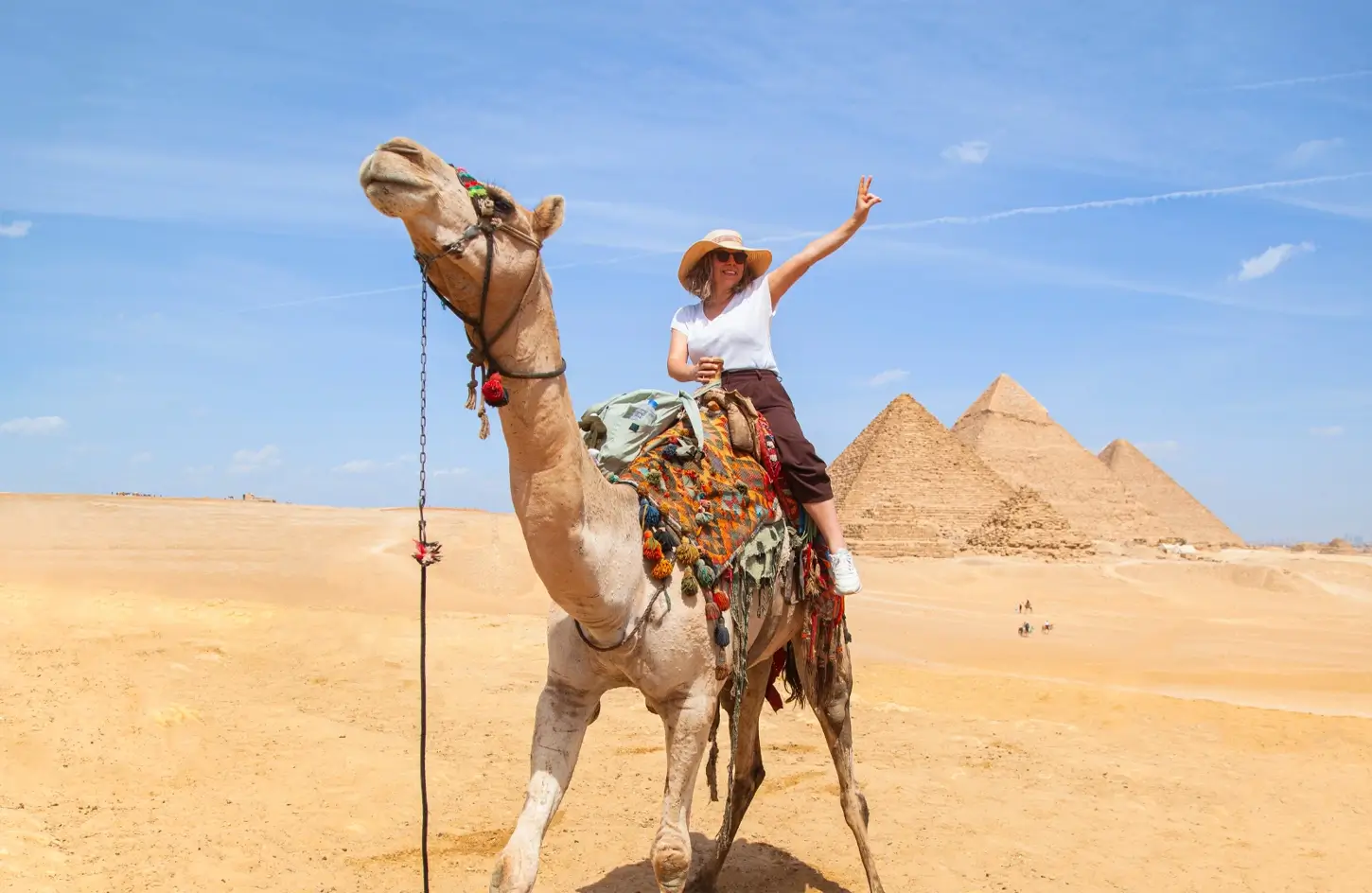
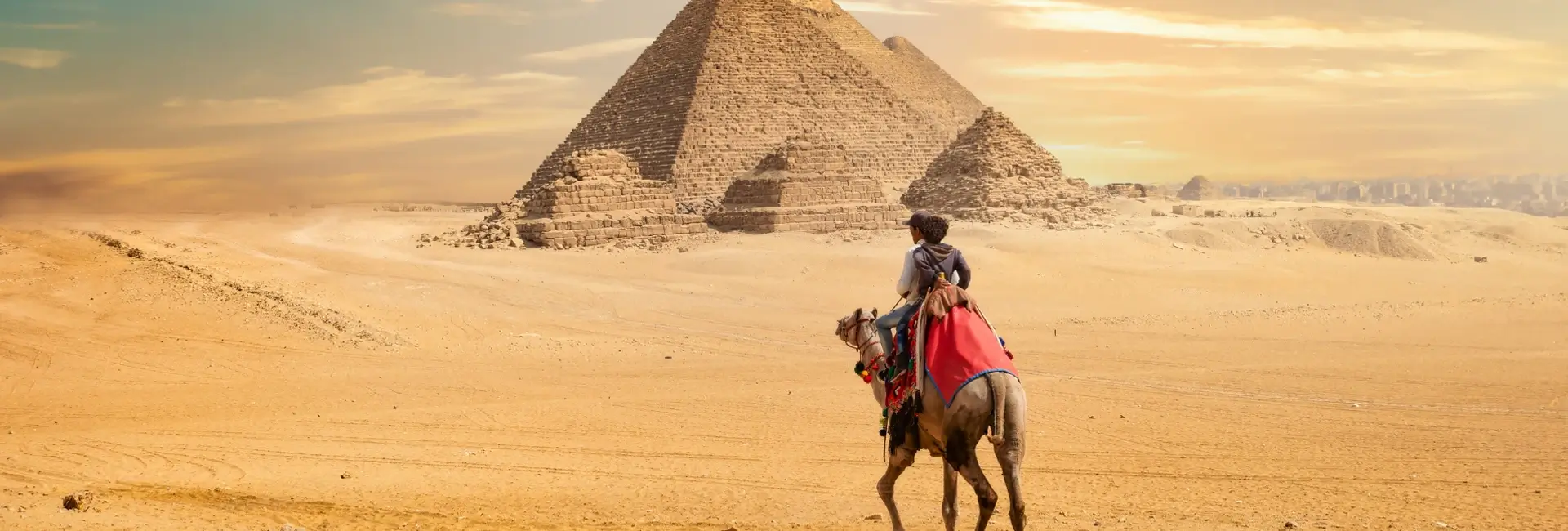
There is no adequate preparation for your first sight of the Pyramids. You can study every photograph, read every description, watch every documentary — and still, when the car crests the Giza plateau road at dawn and the three structures appear against the desert sky, you feel something shift inside you. They are larger than expected. Older than imaginable. More silent than anything built for human glory has any right to be.
The Pyramids of Giza — Still the Greatest Show on Earth
The Great Pyramid of Khufu — 138 meters tall today, originally 146 meters — is the last remaining Wonder of the Ancient World. It was built over approximately 20 years by an estimated 20,000 workers using 2.3 million limestone blocks, some weighing up to 80 tonnes. This is not mythology. This is archaeology.
The Pyramid of Khafre appears taller than Khufu's because it stands on higher ground — look for the surviving cap of original white limestone at its summit, a remnant of what once covered all three pyramids entirely. The Pyramid of Menkaure, the smallest of the trio, is the most humanly proportioned and arguably the most beautiful from close range.
The interior of Khufu's pyramid — reached via a separate ticket — is narrow, hot, and steep. It is also extraordinary. The ascending and descending passages, the Grand Gallery, the King's Chamber in the exact center of the pyramid: standing there, surrounded by 4,500 years of stone, is an experience unlike anything else in the world.
📸 Photo Tip Arrive at exactly 7am when the gates open. Tour groups begin arriving by 9am and the plateau transforms completely. The eastern viewing platform, with all three pyramids aligned in the frame and the morning light gold behind them, is the shot — and at 7am, you may have it entirely to yourself. |
⏰ Opening: 7:00 AM – 4:00 PM daily (summer: 8:00 AM – 5:00 PM) ⏱️ Allow: 2–3 hours for the plateau | Extra time if visiting interiors 💰 Entrance: 360 EGP (plateau) | Interior of Khufu: additional ticket 🧭 Location: Giza Plateau, southwest of central Cairo |
The Great Sphinx — The Oldest Portrait in the World
Carved from a single limestone outcrop approximately 4,500 years ago, the Great Sphinx is 73 metres long and 20 metres tall — the oldest known monumental sculpture on earth. It is believed to represent Pharaoh Khafre, its lion body suggesting royal power and its human face representing divine wisdom. Napoleon's soldiers famously did not shoot off its nose; it was missing centuries before they arrived.
The Sphinx faces due east — toward the sunrise, toward the living. It has been watching the same horizon since before the invention of writing as we know it today. The best vantage point is the eastern platform facing west, where the Great Pyramid rises directly behind the Sphinx's head in the same frame.
💡 Local Tip "The Sphinx is included in your Giza plateau ticket — no separate entry. Most visitors rush past it on the way to the Pyramids. I suggest the opposite: arrive at the Sphinx first, before the plateau fills. Stand in front of it quietly for five minutes. Then walk to the Pyramids. The sequence matters." |
The Grand Egyptian Museum (GEM) — Egypt's Greatest New Attraction
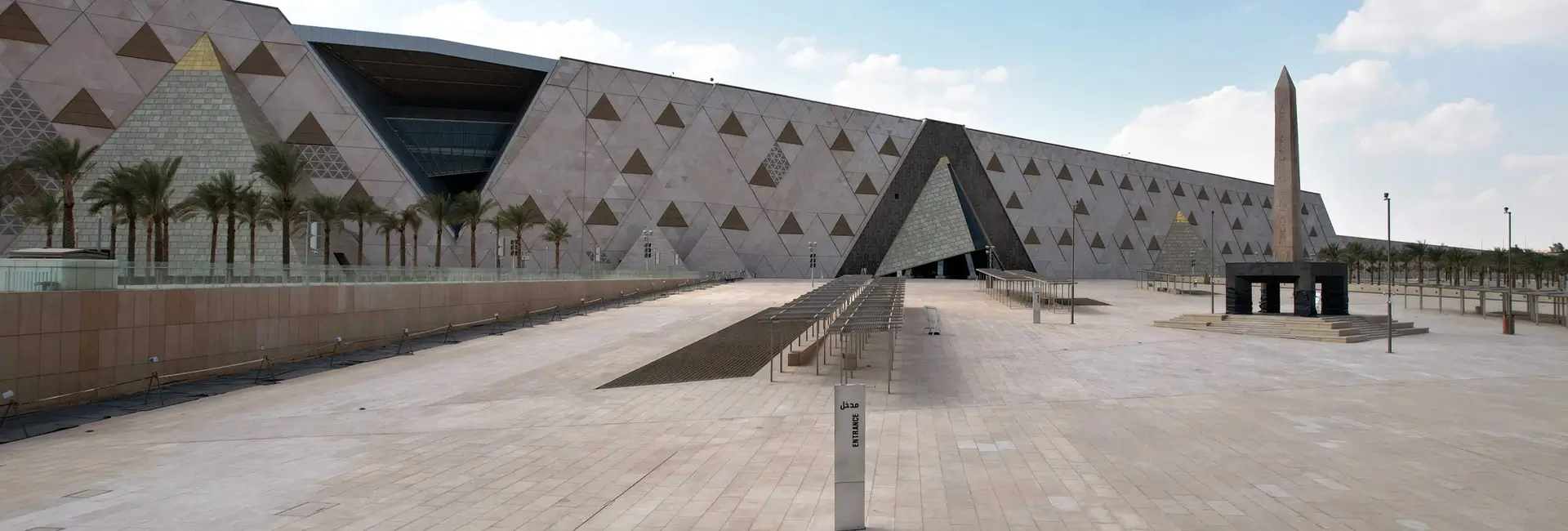
Opened fully in 2025, the Grand Egyptian Museum is the largest archaeological museum in the world by floor area. It houses over 100,000 artefacts, including the complete Tutankhamun collection — all 5,000+ objects from Tomb KV62 displayed together in one place for the very first time in history. The old Egyptian Museum scattered them across multiple rooms over many decades; the GEM unifies them in a dedicated, magnificently lit gallery that finally does them justice.
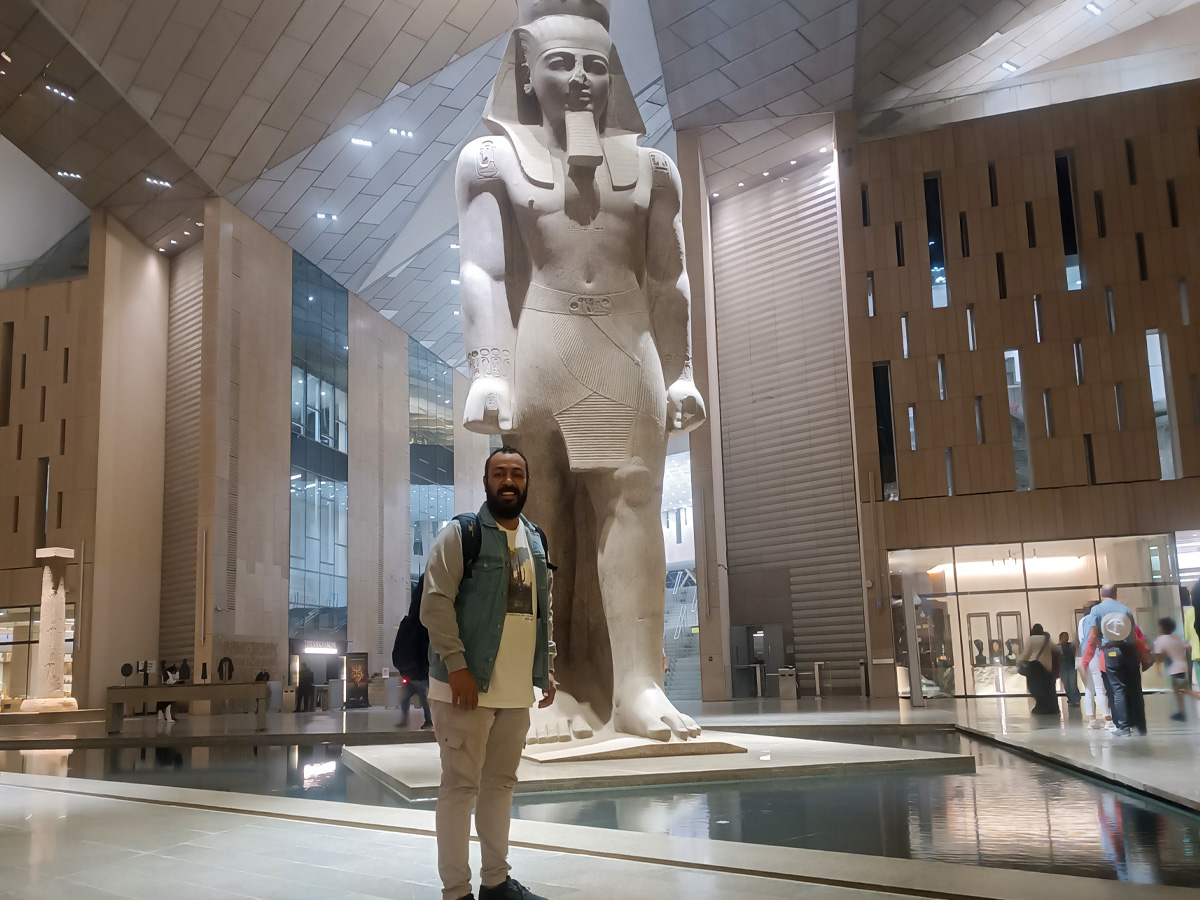
The Grand Atrium alone — a 30-meter-tall glass space dominated by a colossal statue of Ramesses II — is one of the most dramatic interior spaces in Egypt. The Solar Boat Museum houses Khufu's 4,600-year-old funeral vessel, fully preserved and displayed in a purpose-built chamber that communicates the almost impossible craftsmanship of ancient Egyptian shipbuilding. The GEM is not just a museum. It is Egypt's statement to the world about what its heritage means.
💡 GEM Strategy — From the Guide "The GEM is enormous and most visitors leave overwhelmed. Here is the strategy: spend your first 30 minutes only in the Grand Atrium with the Ramesses II statue. Then go directly to the Tutankhamun galleries — every object from KV62, together, perfectly labelled. Then the Solar Boat. Then wander. If you try to see everything systematically, you'll exhaust yourself by gallery four. Follow what moves you." |
⏰ Opening: 9:00 AM – 9:00 PM daily ⏱️ Allow: 2.5–3 hours minimum 💰 Entrance: 900 EGP (main galleries) 🔗 Connected to the Giza necropolis via elevated walkway — plan both in the same day ⚠️ Book tickets online in advance during peak season (October–April) |
🕌 Want a Local Guide to Show You the Cairo Most Visitors Miss? Our Cairo experts have guided over 1,200+ groups through this city. We know the streets, the timings, and the hidden places that no map will show you. Message us on WhatsApp: https://wa.me/201002135997 |
Ancient Day Trips — The Pyramids Before the Pyramids
Most visitors don't realize that the Giza Pyramids were the culmination — not the beginning — of 200 years of pyramid-building experimentation. The smooth, soaring perfection of Khufu, Khafre, and Menkaure was earned through trial and error, failure, and refinement, across a series of sites 30 kilometers to the south. Saqqara and Dahshur tell the story of how humanity got there. They are among Egypt's most rewarding and least visited sites.
Saqqara — The World's First Pyramid and Egypt's Largest Necropolis
The Step Pyramid of Djoser, built around 2650 BCE, is both the world's first large-scale stone building and the first pyramid ever constructed. Its architect, Imhotep — history's first named genius — was later deified by the Egyptians themselves, a tribute granted to almost no human being. Standing at the base of the Step Pyramid, you are standing at the origin point of monumental architecture. Not just Egyptian architecture. All architecture.
The surrounding Saqqara necropolis is vast and extraordinarily varied. The mastaba tombs of nobles are decorated with detailed scenes of everyday life — farmers harvesting, fishermen hauling nets, dancers and musicians at feast — painted over 4,000 years ago with an intimacy that feels almost contemporary. The Serapeum, a network of underground galleries where the sacred Apis bulls were buried in enormous granite sarcophagi, is atmospheric and genuinely eerie.
⏰ Opening: 7:00 AM – 4:00 PM ⏱️ Allow: 2 hours 💰 Entrance: 360 EGP 💡 Combine with Dahshur + Memphis for a full South Cairo day trip |
Dahshur — The Two Pyramids Nobody Visits (But Should)
Dahshur is the answer to the question every thoughtful visitor asks at Giza: how did they learn to build these? The Bent Pyramid and the Red Pyramid, both built by Pharaoh Sneferu in the 26th century BCE, are the evidence of the learning curve — and they are almost always empty of tourists.
The Bent Pyramid is unmistakable: mid-construction, the engineers realised the initial angle was too steep and would be structurally unstable, so they reduced it sharply. The result is a pyramid that kinks visibly about two-thirds of the way up — a monument to the moment of realisation. The Red Pyramid, built next, got the angle right: the world's first successful true pyramid. Its interior is the most accessible and least claustrophobic pyramid interior in Egypt, and you can walk it alone.
💡 Local Tip "Dahshur is one of my favourite sites in Egypt precisely because it's almost always empty. There are no tour group buses here. No vendors crowding the entrance. Just the desert, the pyramids, and the extraordinary silence. If you have three days in Cairo, this day trip is non-negotiable." |
⏰ Opening: 7:00 AM – 4:00 PM ⏱️ Allow: 1.5 hours 💰 Entrance: 100 EGP 🔵 One of Egypt's most undervisited ancient sites |
Memphis — The Ancient Capital That Started Everything
Memphis was once the most powerful city on earth — the capital of unified Egypt for over 3,000 years, the administrative, religious, and cultural centre of the ancient world's greatest civilisation. Today it survives as a modest open-air museum, but what survives carries extraordinary weight: a colossal alabaster Sphinx (the second-largest in Egypt) and the enormous recumbent statue of Ramesses II, its scale startling even lying on its side.
Allow 45 minutes and absorb the historical significance as much as the objects. Memphis is best visited as part of the Saqqara–Dahshur–Memphis day loop, with a private driver hired for the full day through your hotel.
⏰ Opening: 7:00 AM – 4:00 PM ⏱️ Allow: 45 minutes 💰 Entrance: 100 EGP |
Islamic Cairo — A Thousand Years of Living History
Islamic Cairo is the city that most surprises visitors. They arrive expecting a museum quarter. They find a living, breathing medieval city — mosques still active, markets still trading, craftsmen still working the same trades in the same streets their great-great-grandparents worked. The density of Islamic monuments here is unmatched anywhere in the world, and the atmosphere, especially in the morning and at dusk, is unlike anything else.
Al-Muizz Street — The Most Beautiful Street in the Islamic World
Built in 969 CE and UNESCO-listed, Al-Muizz li-Din Allah Street contains the highest concentration of medieval Islamic monuments anywhere on earth. In one kilometre, you walk past mosques, madrasas, wikalahs (merchants' caravanserais), sabils (public fountains), and palaces dating from the 10th to the 19th centuries — all still in daily use, all still in the street they were built in over a thousand years ago.
Walking Al-Muizz in the morning is walking through a living museum. But what makes it extraordinary is what it isn't: it is not a reconstructed heritage zone, not a carefully preserved open-air exhibit. The butcher's shop is open. The carpenter is at work. The schoolchildren are heading to Al-Azhar. This is simply Tuesday in a neighbourhood where Tuesday has looked roughly like this for 1,000 years.
📸 Photo Tip Go in the morning (9am–12pm) for architecture in clean light, then return at sunset when the flood-lighting comes on and the minarets and stone façades turn gold. The evening is Al-Muizz at its most cinematic. |
Khan el-Khalili Bazaar — Six Centuries of Commerce
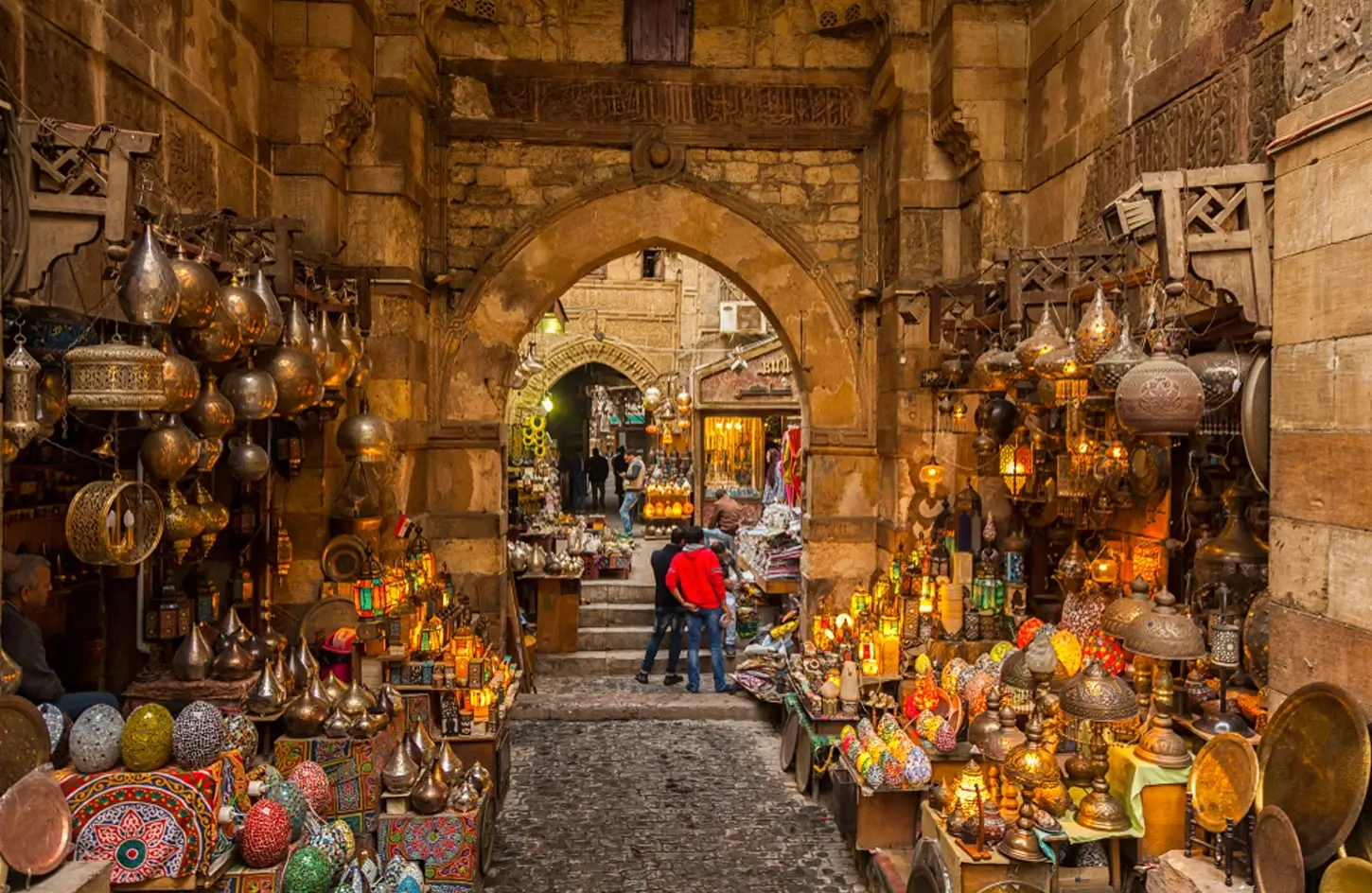
One of the world's oldest and most intact historic bazaars, Khan el-Khalili has been trading continuously since 1382 CE. It sells copper lanterns, spices, gold jewellery, handmade papyrus, perfume, silk scarves, hookah pipes, and everything in between — but what you're really coming for is the atmosphere, which no inventory list can convey.
El Fishawy Café — open 24 hours since 1773 — is at the heart of the bazaar's oldest alley. The Nobel Prize-winning novelist Naguib Mahfouz sat at its tables most evenings for decades. Order tea with mint, find a chair facing the alley, and spend an hour watching Cairo move past you. This is more educational than any museum and will cost you less than a coffee in London.
💡 Insider Tip — The Fishawy Rule "Every visitor to Cairo should spend one hour at El Fishawy. Not rushing through for a photo — actually sitting. The copper walls, the mirrors, the lanterns, the sound of Cairo just outside. Naguib Mahfouz understood why this place matters. When you sit long enough, you'll understand too." |
On prices: go for the atmosphere, not as a budget shopping destination. Shops on the outer ring of the bazaar are significantly cheaper than those in the tourist-facing inner lanes. Haggling is expected and accepted with good humor.
Saladin Citadel & the Muhammad Ali Mosque — Cairo from Above
Built by Saladin in 1176 CE to defend Cairo against Crusader attack, the Citadel of Saladin (Qal'at al-Jabal) has dominated Cairo's skyline for nearly 850 years. From its eastern walls, the city makes sudden sense: the minarets stretching south toward old Cairo, the Nile gleaming in the west, and in the distance — always — the three silhouettes of Giza. A city 1,400 years old with a view 4,500 years old.
The Muhammad Ali Mosque (the Alabaster Mosque) rises from within the Citadel in Ottoman style, its twin minarets visible from across the city. Inside, the alabaster-clad walls and painted dome create one of Cairo's grandest interior spaces. Directly below the Citadel walls, the Sultan Hassan Mosque — built between 1356 and 1363 — is one of the supreme achievements of Mamluk architecture. Its courtyard is vast and humbling, its proportions so perfect they have been studied by architects ever since.
⏰ Opening: 7:00 AM – 5:00 PM ⏱️ Allow: 2 hours (Citadel + Muhammad Ali Mosque + Sultan Hassan + Al-Rifa'i) 💰 Entrance: 360 EGP (includes Muhammad Ali Mosque) 💡 Visit in the late afternoon for the best light on the Citadel walls |
Al-Azhar Mosque — The Heart of Sunni Islam
Founded in 972 CE, Al-Azhar is one of the world's oldest continuously operating universities — a centre of Islamic scholarship that has attracted students from across the Muslim world for over a thousand years. The mosque itself is free to visit (modest dress required, shoes removed at the entrance). The surrounding neighbourhood of Al-Azhar is largely undiscovered by most tourists, which makes it one of Islamic Cairo's most authentically atmospheric pockets.
💡 Insider Tip Visit in the morning, well before Friday prayers. The main courtyard — white marble, pointed arches, a fountain at the centre — is peaceful and architecturally magnificent in the early light. Few tourists come here, which is a gift. |
Ibn Tulun Mosque — The Secret Great Mosque
Built in 879 CE, Ibn Tulun is Cairo's oldest functioning mosque and one of its largest. Its spiral minaret — inspired by the Great Mosque of Samarra in modern Iraq — is unique in Egypt. Its courtyard is as large as a football pitch and, on most mornings, almost completely silent. No tour groups. No vendors. Just the fountain at the centre, the carved stucco screens, and the weight of eleven centuries.
The surrounding neighborhood of Sayyida Zainab is authentic working-class Cairo at its best — busy, noisy, generous. Ibn Tulun is what Cairo visitors miss when they spend all their time in Khan el-Khalili. It is one of my strongest recommendations for any visitor with more than two days in the city.
📸 Photo Tip The colonnaded arcade around the courtyard creates extraordinary repeating geometry in the morning light. Come between 9am and 11am on a clear day. Free to visit outside prayer times. |
Coptic Cairo — Egypt's Oldest Christian Quarter
Coptic Cairo is one of Egypt's most profound surprises. Most visitors arrive at Giza with the Pyramids in mind and at Islamic Cairo for the mosques — and overlook entirely a neighbourhood that predates both by several centuries. This is where Christianity in Egypt began, where the Holy Family is believed to have sheltered during the Flight into Egypt, and where a living Christian community has maintained its faith in an unbroken line for nearly 2,000 years.
The Hanging Church — Cairo's Most Famous Coptic Church
The Church of the Virgin Mary — known universally as the Hanging Church because it is built directly above the Roman fortress of Babylon, suspended over the ancient watchtowers — is the most iconic Coptic church in Egypt. Parts of the current structure date to the 4th century CE, making it one of the oldest churches in Africa.
Inside, the silence is startling. In the middle of Cairo's relentless noise, this place has been hosting quiet prayer since before the city existed in its current form. The carved wooden screen separating the nave from the sanctuary, the painted icons, and the Byzantine-era marble pulpit in the shape of a boat supported by columns representing the twelve apostles are all extraordinary. Modest dress is required, and the atmosphere rewards respectful, unhurried attention.
⏰ Open: 9:00 AM – 4:00 PM daily 💰 Free to enter | Modest dress required 📍 Old Cairo / Coptic Cairo — accessible via Metro (Mar Girgis station) |
The Coptic Museum — Egypt's Christian Heritage in Full
The Coptic Museum holds the largest collection of Coptic art and archaeology in the world — over 16,000 objects tracing the story of Christianity in Egypt from the first century CE to the modern era. Textiles, manuscripts, icons, carved stone, liturgical objects — the breadth and quality of the collection are remarkable, and the building itself (beautiful garden, cool courtyards, excellent signage) makes it one of Cairo's most pleasant museum experiences.
It is also significantly less crowded than the Egyptian Museum and far smaller than the GEM, which means you can move through it at a real pace and absorb what you see. Allow 90 minutes. The garden is a lovely place to sit afterward.
⏰ Open: 9:00 AM – 5:00 PM daily 💰 Entrance: 150 EGP |
Church of St. Sergius & Bacchus and Ben Ezra Synagogue
The Church of St. Sergius and Bacchus — Abu Serga in Arabic — is built over the crypt where the Holy Family is believed to have sheltered during their flight into Egypt from Herod's persecution. The crypt itself is accessible, narrow, and remarkable. It is the oldest church in Cairo and one of the oldest pilgrimage sites in the Christian world.
The Ben Ezra Synagogue — one of the oldest synagogues in Africa — stands just metres away. This is where the Cairo Geniza was discovered in 1896: a cache of over 600,000 medieval Jewish documents, stored in a sealed chamber for centuries, that transformed scholars' understanding of Jewish life in the medieval Middle East. The building is peaceful and beautifully maintained.
💬 From the Guide "In one block in Coptic Cairo, you can stand in places sacred to Christians, Jews, and Muslims — from different centuries, all still in use. That's Cairo in miniature. The city has always been layered this way. It's one of the things I love most about it." |
Cairo After Dark — The City That Belongs to the Night
Cairo is two different cities. The daytime city is extraordinary. But the night city is something else entirely — louder, warmer, more alive, and in some ways more honestly itself. Egyptians are night people. The streets fill after sunset. The restaurants and cafés don't reach their peak until 10pm or later. The Nile reflects the city lights. The bazaar lanterns come on. Cairo at night is non-negotiable.
Nile Dinner Cruise — Cairo from the Water
The Nile dinner cruise is a Cairo classic: a 2–3 hour sailing along the river with dinner, live music, belly dancing, and a traditional Tanoura whirling performance on board. It is not the most culturally austere evening in Egypt. It is, however, one of the most visually spectacular — watching an illuminated Cairo slip past from the water, the bridges lit, the towers reflected in the Nile, is genuinely beautiful.
Most hotels on the Corniche can arrange bookings. Budget cruises start at approximately USD 20–30 per person; mid-range options with better food and production values run USD 50–80. For a first evening in Cairo after a day on the Giza plateau, the contrast is extraordinary.
Khan el-Khalili at Night — When the Bazaar Transforms
After 7 pm, the tourist shops thin out and the local cafés and tea houses fill up. The lanterns of the bazaar alleys — copper and coloured glass, hundreds of them — are lit from within, casting warm light across the medieval stonework. El Fishawy is full. Someone is playing backgammon. Someone else is having an argument that sounds more serious than it is. This is Cairo's most photogenic night scene, and it costs nothing to walk through.
💬 From the Guide "Every time I bring visitors to Khan el-Khalili in the evening, they ask: 'Why didn't we come here first?' Because you have to see Cairo in the day first, to understand what the night transforms it into. Come here last. It will be the thing you remember." |
The Pyramids Sound & Light Show — Ancient Monuments After Sunset
An evening theatrical performance at Giza — the Pyramids and Sphinx dramatically illuminated, with a narrated history of ancient Egypt played through speakers across the plateau. The show runs for 45 minutes, with performances available in multiple languages on most evenings. The Pyramids at night — lit from below against a dark sky — are extraordinary in any context. Sit in the back rows for the best viewing angle and the coolest air.
Zamalek — Cairo's Most Liveable Island
On Gezira Island in the middle of the Nile, Zamalek is the neighbourhood where many of Cairo's diplomats, artists, and creatives choose to live — and it shows. Tree-lined streets, independent bookshops, art galleries, excellent restaurants, and the Cairo Opera House, which hosts world-class performances from October through June. A completely different Cairo from the historic zones — elegant, calm, international in feel, and yet entirely Egyptian in character.
💡 Local Tip "Zamalek is where Cairenes go when they want to forget they live in a city of 22 million people. An evening walk from the Opera House along the Corniche to the northern tip of the island, with the bridges lit and the river on both sides, is one of the city's great pleasures. No ticket required." |
Planning Your Cairo Days — Practical Structure
Cairo rewards planning. The city's extraordinary density of experience means that an unstructured day can dissolve into traffic and indecision. Here is how I would divide your time — definitively, not as one option among many.
If You Have 1 Day in Cairo
7:00 AM: Arrive at Giza Plateau at opening — 2–3 hours, including the Sphinx.
10:30 AM: Grand Egyptian Museum — 2.5 hours minimum. Focus on the Tutankhamun galleries and Solar Boat.
1:30 PM: Lunch near the GEM or in Giza.
3:00 PM: Khan el-Khalili bazaar — 2 hours. Buy souvenirs, have tea at El Fishawy.
Evening: Nile dinner cruise or Pyramids Sound & Light Show.
💬 From the Guide "One day is not enough for Cairo. But this gives you the Pyramids, the greatest museum in the world, the oldest bazaar in Africa, and the Nile at night. That's more history per hour than almost anywhere on earth." |
If You Have 2 Days in Cairo
Day 1 Morning: Giza Plateau — Pyramids + Sphinx.
Day 1 Afternoon: Grand Egyptian Museum.
Day 1 Evening: Khan el-Khalili + El Fishawy Café.
Day 2 Morning: Islamic Cairo — Al-Muizz Street + Saladin Citadel + Muhammad Ali Mosque.
Day 2 Afternoon: Coptic Cairo — Hanging Church + Coptic Museum + Abu Serga.
Day 2 Evening: Zamalek for dinner, or Nile dinner cruise.
If You Have 3 Days in Cairo
Days 1 and 2 as above.
Day 3: Full-day private driver south — Saqqara + Dahshur + Memphis. Return via Al-Azhar Park for sunset over the medieval city.
💡 Local Verdict "Three days is the minimum that does Cairo justice. If your itinerary gives you only two, choose well. If you have flexibility to add a third, take it without hesitation. The South Cairo day trip — Saqqara, Dahshur, Memphis — is one of Egypt's most rewarding days and consistently surprises visitors who thought they'd already seen the best of it." |
Entrance Fees & Opening Times — Cairo Quick Reference
Site | Area | Opens | Closes | Fee | Notes |
Pyramids of Giza | Giza | 7:00 AM | 4:00 PM | 360 EGP | Interior tickets extra |
Great Sphinx | Giza | 7:00 AM | 4:00 PM | Included | With Giza plateau ticket |
Grand Egyptian Museum | Giza | 9:00 AM | 9:00 PM | 900 EGP | Book online in peak season |
Saqqara | South Cairo | 7:00 AM | 4:00 PM | 360 EGP | Combine with Dahshur + Memphis |
Dahshur | South Cairo | 7:00 AM | 4:00 PM | 100 EGP | Almost always uncrowded |
Memphis | South Cairo | 7:00 AM | 4:00 PM | 100 EGP | 45-minute stop |
Saladin Citadel | Islamic Cairo | 7:00 AM | 5:00 PM | 360 EGP | Includes Muhammad Ali Mosque |
Coptic Museum | Coptic Cairo | 9:00 AM | 5:00 PM | 150 EGP | — |
Hanging Church | Coptic Cairo | 9:00 AM | 4:00 PM | Free | Modest dress required |
Al-Azhar Mosque | Islamic Cairo | Variable | Variable | Free | Avoid prayer times |
Khan el-Khalili | Islamic Cairo | 10:00 AM | 11:00 PM | Free | Friday hours vary |
⚠️ All fees are approximate and subject to change — verify locally on arrival. Egyptian monument fees are updated periodically.
Getting Around Cairo — Honest Transport Guide
Cairo traffic is legendary. Plan for it honestly: allow 30–60 extra minutes for any journey during morning rush hours (7–9am) and evening rush hours (5–8pm). This is not an exaggeration. It is the most consistent piece of advice I give every visitor.
• Uber: The best option for first-time visitors. Fixed price, no negotiation, GPS tracking, driver accountability. Use it for almost everything.
• Careem: The Egyptian equivalent of Uber — equally reliable. Have both apps downloaded.
• Cairo Metro: Fast and cheap for specific routes (Tahrir Square ↔ Coptic Cairo via Mar Girgis station is the most useful for tourists). Women-only carriages available on every train.
• White taxis: Always negotiate and agree the fare before you get in. Never after.
• Private driver for the day: Best value for covering multiple sites (Giza + GEM + Islamic Cairo in one day, or the South Cairo day trip). Ask your hotel to arrange — typically USD 50–80 for a full day, including driver and car.
Your Cairo Trip Starts Here
Cairo is not a destination you tick off a list. It is a city that accumulates inside you — the Pyramids, yes, but also the call to prayer bouncing off the medieval stonework of Al-Muizz at dusk, and the sound of hammers on copper in a workshop in Khan el-Khalili, and the Nile at night with the bridges lit and the city still going at midnight. Most visitors leave planning to come back. Most of them do.
🕌 Want a Local Guide to Show You the Cairo Most Visitors Miss? Our Cairo experts have guided over 1,200+ groups through this city. We know the streets, the timings, and the hidden places that no map will show you. Message us on WhatsApp: https://wa.me/201002135997 |
Internal Links
Anchor Text | Destination |
Egypt Itinerary 10 Days | → Post #5 (this series) |
Egypt Travel Tips for First-Timers | → Post #2 (this series) |
How to Get from Cairo to Luxor | → Post #8 (this series) |
Grand Egyptian Museum Guide | → Post #13 (this series) |
Where to Stay in Cairo | → Post #15 (this series) |
Is Egypt Safe for Tourists? | → Post #12 (this series) |
Best Time to Visit Egypt | → Post #1 (this series) |
Egypt Packing List | → Post #11 (this series) |
How to Plan an Egypt Trip | → Post #10 (this series) |
Cairo Tours & Day Trips | → Egypt Tailored Tours.com/cairo-tours |
Egypt Tour Packages | → Egypt Tailored Tours.com/egypt-tours |
Frequently Asked Questions
Q: How many days do you need in Cairo?
A minimum of 2 full days is recommended for a first visit — one day for the Giza Plateau and the Grand Egyptian Museum, and one day split between Islamic Cairo and Coptic Cairo. Three days adds the Saqqara and Dahshur day trip and allows a more relaxed pace. Most travelers who give Cairo three days describe it as still not quite enough.
Q: Is the Grand Egyptian Museum worth visiting?
Absolutely — the GEM is arguably the most important museum opening of the 21st century. It houses over 100,000 artefacts including the complete, unified Tutankhamun collection displayed together for the first time in history. Its scale, curation, and dramatic architecture make it the most impressive museum experience in Egypt. Allow 2.5–3 hours and book tickets in advance during peak season (October–April).
Q: What is the best area to stay in Cairo?
For first-timers: Downtown Cairo (near Tahrir Square) for easy access to the metro, restaurants, and the old Egyptian Museum. Giza for proximity to the plateau and the GEM. Zamalek (Gezira Island) is a quieter, more elegant neighborhood with excellent restaurants and walking streets. All three are valid choices — your preference depends on whether you prioritize history, convenience, or atmosphere.
Q: Is Cairo safe for tourists in 2026?
Cairo is generally safe for tourists, particularly in the areas around Giza, Islamic Cairo, Coptic Cairo, and Zamalek. Normal urban awareness applies — keep valuables secured, use Uber rather than street taxis, and move confidently through crowded areas. The tourist police presence is strong at all major sites. Solo women travelers should be aware that the more conservative areas of the city require modest dress.
Q: What is Khan el-Khalili, and is it worth visiting?
Khan el-Khalili is one of the world's oldest and most intact historic bazaars — trading continuously since 1382 CE. It sells handmade copper lanterns, spices, gold jewelry, papyrus, and textiles. It is worth visiting both for the shopping and, more importantly, for the atmosphere — especially after dark, when the lanterns are lit, and El Fishawy Café fills with locals. Haggle firmly on prices.
Q: Can I visit Saqqara and Dahshur as a day trip from Cairo?
Yes — both are easily combined into a single full-day trip from Cairo, along with the ancient city of Memphis. The drive south takes 30–45 minutes from central Cairo. Hire a private driver for the day (your hotel can arrange this) for the most flexible experience. This day trip is strongly recommended for anyone with three or more days in Cairo who wants to understand the full story of pyramid-building beyond Giza.